REVIEW: Anne Boleyn (Auckland Theatre Company)
The Other Woman [by James Wenley]
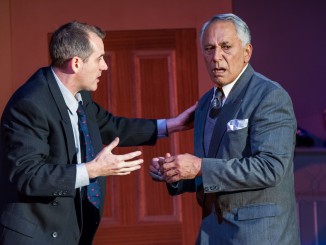
Boleyn comes encumbered by reputation. She’s called a great deal many things through the course of the play: “the harlot queen”, “intolerable woman”, “witch”, “the whore”. She’s arguably subject to one of history’s great hatchet jobs, the dangerous female who bewitched a King and tore England asunder. For his 2010 drama, Howard Brenton recasts and reclaims Anne as a tragic heroine who seeks to make her own place within the male-dominated factions of Henry VIII’s court, and by winning the King’s love, and the King’s ear, steers world history on a different course.
Brenton’s Anne, by way of Anna Julienne, is driven by a potency of burning ambition, higher ideal, changing-the-world zeal, and, yes, love.
Whereas Anne’s sister Mary succumbed to the King, and subsequently found herself out of favour, Anne knows the value of sex as tool. Anne catches Henry’s attention when she throws an orange at him during a court masque. There is a suggestion that what propels Henry’s interest is Anne’s decided delay in bearing all her fruits; a tortured Henry asks to see “a little further than the knee”. Seven years later, Anne and the King finally consummate their courtship. The King suggests this would be a good time for an interval.
The play is like that – there are serious weighty themes, not least the fierce battle for England’s religious soul, tied up with sexual bawdy and theatrical winks to the crowd. For this, Brenton takes his cue from Shakespeare’s mingling of high and low.
REVIEW: Death of a Salesman (Peach Theatre Company)
I’m sold [by Matt Baker]
In his opening night speech, director Jesse Peach obscurely alluded to the possibility of Death of a Salesman being his last production*. While I actively concede that this may have been a misinterpretation of inarticulate speech, I would like to think that going out on a high note is the correct course of action in the case of Peach Theatre Company, as a high note has now been achieved.
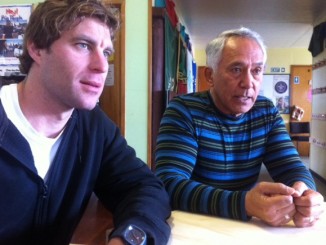
Programme notes and post-show audience commentary of the play beat the more-relevant-now-than-ever drum, yet, I would riposte, when has it not been? Even before we left the jungle, when have the concepts of success, monetary gain, parental delusion, parental worship, delusions of grandeur, self-achieved submission, and family not been relevant? A play’s success comes from the universality and timelessness of its themes, and, while the social, economic, and political climate of a city/country in which a play is produced should have some relevance, I found far more in the story between father and son than in that of the American Dream. This is not due to any lack on the part of George Henare as the eponymous salesman (there is, quite simply, nothing that Henare lacks as an actor) or the apathy-inducing over-abundance of economic/financial hardship we see purported in the media, but can instead be ascribed to the complexity, empathy, and power of Ian Hughes’ portrayal of Biff.
PREVIEW: Death of a Salesman (Peach Theatre Company)
Miller's Memorable Masterpiece [by Sharu Delilkan]
The minute Richard Knowles heard that Peach Theatre Company was staging Death of a Salesman he lost no time contacting producer/director Jesse Peach.
“I studied Death of a Salesman at school and I even used one of the monologues for my audition at Toi Whakaari. So I wanted to be involved in any way I could. And when I heard George Henare was going to be Willy I wanted to be a part of it even more.”
Knowles says he was privileged to see Henare playing Willy in Circa’s production of the same show in 2006.
“George’s portrayal of Willy Loman absolutely blew me away. It’s really amazing to be sharing the stage with him and see him work. His treatment of Willy in this production is very different from what I saw, which makes it all the more interesting.”
REVIEW: Othello (Peach Theatre Company)
Honestly, Iago... [by James Wenley]
It might be called Othello, but this one is very much Iago’s show.
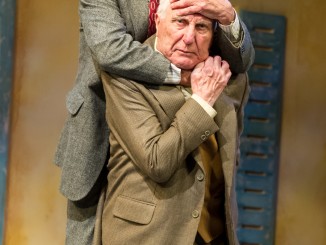
Iago, the villain in Shakespeare’s Othello, has long threatened to outshine the titular tragic hero. Shakespeare for one gave him substantially more lines and a relentless destructive driving force, plotting to destroy the Moor that he says he hates. Why Iago does what he does has forever been debated by the academics, and his motivations make him a continually fascinating character, an interpretative draw card for directors and the actors who play him. This is not to diminish Othello’s story, rich in its own issues of identity, difference and the tragic fall, but Iago is far more fun. Especially, in Jesse Peach’s production.