Theatre Scenes: Auckland Theatre Blog (Reviews, interviews and commentary)
20May/130

REVIEW: The Glass Menagerie (Auckland Theatre Company)

A precious piece [by Matt Baker]

The Glass Menagerie

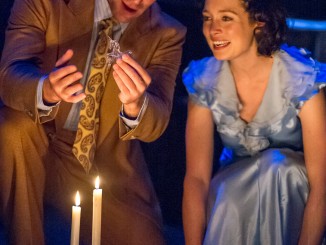
Richard Knowles and Antonia Prebble in the Auckland Theatre Company production of The Glass Menagerie

The Glass Menagerie is a magical play. From the opening Brechtian monologue, to the blatant symbolism and dialogue surrounding the titular menagerie, playwright Tennessee Williams does not shy away from using a light theatrical shroud to expose truths. It would be easy to rely on these conventions and consequentially not find the true weight in his writing, but Auckland Theatre Company’s production of The Glass Menagerie is a beautiful blend.

Edwin Wright sets a wonderful pace for the play and continues to push through with a strong internal drive. He also finds a great amount of humour in Tom’s sardonic wit. Once the trap is set and Amanda really has something to play with, Elizabeth Hawthorne shines with total southern abandon. Hawthorne finds all the colours and tones to her vocals, and turns her words to flesh, a reminder to all actors that, according to Peter O’Toole, eighty percent of what an actor does is with their voice.

Antonia Prebble takes on what could be considered the most difficult role in the play, in that Laura could be easily distanced from the audiences' empathy with too much ‘poor me’ acting. To counteract this, Prebble is slightly showy, but ironically maintains an equal amount of theatricality to her co-stars. The limp comes and goes, but the innate nature of Laura is always there.

10Mar/120

REVIEW: Much Ado about Nothing (Summer Shakespeare)

Shakespeare does it again! [by James Wenley]

Much Ado about Nothing

Turns out that Much Ado about Nothing is actually much ado about quite a lot of things…

In some ways a ‘greatest hits’ of Shakespeare’s devices, Much Ado’s comedy takes in bumbling authority figures, a disguised seduction, various tricks played on characters, a Shrew-like Battle of the Sexes… there’s even a sort of small boy Richard III villain, and the plot threatens to get all Romeo and Juliet when, upon the suggestion of the friar (you have to watch out for them), the heroine Hero fakes her own death. In brief, such stuff that Shakespeare does so well.

The University of Auckland Outdoor Summer Shakespeare production, directed by Sam Pascoe, promises Shakespeare under the stars. With this weather, it’s more accurate to say Shakespeare under the clouds. No matter, for who would want to be watching the skies when the action on the lawn is so good.

Much Ado revolves around two couples – Claudio and Hero, who fall instantly in love with each other, and Benedick and Beatrice, who fall instantly in hate. But when they are tricked into thinking that the other one loves them, Benedick and Beatrice tie themselves instead into love knots.

13Dec/115

REVIEW: The Waste Land (ATC Participate)

April is the cruelest month... [by James Wenley]

The Waste Land

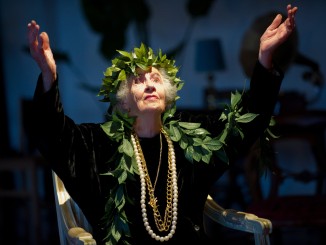
T.S. Eliot, eat your heart out. Michael Smith Photography Ltd

Last week I was fortunate enough to experience a profound theatrical event. It’s been a few days now – most productions wash off soon after viewing – but in this one I keep returning to its moment in my head.

I find experiences like these are all too rare, but it’s what keeps me coming back to theatre; the promise of being taken out of my body, to be transported to an undiscovered territory, to feel something new. And when that promise is realised, it’s a special thing indeed.

T.S Eliot’s 1922, 432-line poem The Waste Land is considered one of the most important works of literature of the 20th Century. I don’t claim to understand it. It’s a work that rewards the academic, full of allusions and depths to unravel. It flicks from image to image, voice to voice.

But as a poem, it contains its own sort of dark power. Certain words and phrases linger on the tongue. There’s an obsession with mortality and death. It’s a poem that means many different things to many different people, but within its words, you might just find the totality of existence.

The poem is given a startling voice and vitality in a theatrical interpretation by director Michael Hurst, the first production in Auckland Theatre Company’s Participate program. What immediately distinguishes the production is Hurst is working with a company of 34 actors, an immense number that professional stages costs hardly allow. What then makes the production exceptional is that this company of 34 are all aged 65 years old and over. Some were alive before The Waste Land had even been written. It’s an age group that is rarely given a voice and platform in the professional arts, and certainly never in these sorts of numbers.