Theatre Scenes: Auckland Theatre Blog (Reviews, interviews and commentary)
30Apr/120

PREVIEW: A Midsummer Night’s Dream (Auckland Theatre Company)

In Love with Shakespeare [by Sharu Delilkan]

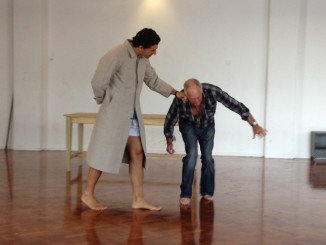
(L-R) Xavier Horan (Oberon) rehearsing with theatre stalwart Raymond Hawthorne (Puck)Photo by Edward Peni

It has been a journey of self-discovery for Xavier Horan, particularly since he has gone from being a ‘Shakespeare-phobe’ to acting in two of his plays within a matter of months.

Horan, who has recently performed at The Globe Theatre London in the ground breaking Maori production of Troilus and Cressida, is extremely excited about his role as Oberon in Auckland Theatre Company's latest production A Midsummer Night's Dream.

He is equally chuffed about being part of the 18-strong stellar cast which includes father daughter duo Stuart Devenie (Egeus) and Laurel Devenie (Helena) as well as Alison Bruce (Titania), Goretti Chadwick (Hippolyta), Peter Daube (Theseus), Andrew Grainger (Bottom), Raymond Hawthorne (Puck), Rima Te Wiata (Peter Quince) and Brooke Williams (Hermia).

A Midsummer Night's Dream features three interlocking plots, connected by a celebration of the wedding of Duke Theseus of Athens and the Amazon queen, Hippolyta, and set simultaneously in the woodland, and in the realm of Fairyland, under the light of the moon.

Horan admits that the whole Shakespeare experience was very scary at first, due to the fact that he was treading on unfamiliar territory. However he says working closely with veteran thespian Hawthorne has been his saving grace.

6Apr/120

PREVIEW: Troilus and Cressida (Auckland Town Hall to The Globe Theatre)

Te be, or not te be? [by Sharu Delilkan]

Rachel House director of Triolus and Cressida

It has been a journey of a lifetime for Rachel House to direct the first Te Reo Maori version of William Shakespeare's historical masterpiece, Troilus and Cressida.

Despite being one of the country’s foremost theatre practitioners and visionaries, House admits she was terrified, when she was first approached.

“I knew this was a massive undertaking and would be history in the making. However that fear disappeared very quickly and we just got on with it.”

Translated by Te Haumihiata Mason, audiences have a last chance on Sunday April 15 to witness this historic production at the Auckland Town Hall before the production plays at The Globe Theatre London, part of the Globe to Globe Festival that is bringing together artists from all over the globe, to present Shakespeare’s plays in their own language.

10Mar/120

REVIEW: Much Ado about Nothing (Summer Shakespeare)

Shakespeare does it again! [by James Wenley]

Much Ado about Nothing

Turns out that Much Ado about Nothing is actually much ado about quite a lot of things…

In some ways a ‘greatest hits’ of Shakespeare’s devices, Much Ado’s comedy takes in bumbling authority figures, a disguised seduction, various tricks played on characters, a Shrew-like Battle of the Sexes… there’s even a sort of small boy Richard III villain, and the plot threatens to get all Romeo and Juliet when, upon the suggestion of the friar (you have to watch out for them), the heroine Hero fakes her own death. In brief, such stuff that Shakespeare does so well.

The University of Auckland Outdoor Summer Shakespeare production, directed by Sam Pascoe, promises Shakespeare under the stars. With this weather, it’s more accurate to say Shakespeare under the clouds. No matter, for who would want to be watching the skies when the action on the lawn is so good.

Much Ado revolves around two couples – Claudio and Hero, who fall instantly in love with each other, and Benedick and Beatrice, who fall instantly in hate. But when they are tricked into thinking that the other one loves them, Benedick and Beatrice tie themselves instead into love knots.

25Jul/110

REVIEW: Othello (Peach Theatre Company)

Honestly, Iago... [by James Wenley]

Othello Peach Theatre Company

Who is Othello really about?

It might be called Othello, but this one is very much Iago’s show.

Iago, the villain in Shakespeare’s Othello, has long threatened to outshine the titular tragic hero. Shakespeare for one gave him substantially more lines and a relentless destructive driving force, plotting to destroy the Moor that he says he hates. Why Iago does what he does has forever been debated by the academics, and his motivations make him a continually fascinating character, an interpretative draw card for directors and the actors who play him. This is not to diminish Othello’s story, rich in its own issues of identity, difference and the tragic fall, but Iago is far more fun. Especially, in Jesse Peach’s production.

18Jul/110

INTERVIEW: Jesse Peach

From the Moor of Venice, to the road of yellow brick... [by James Wenley]

Othello Peach Theatre Company

Robbie Magasiva plays Othello, directing by Jesse Peach.

If you’ve noticed journalist Jesse Peach’s absence from the TV news recently he has a very good reason. He’s taken five months leave to pursue his passion. Theater director Jesse Peach is now at work.

His first play, Othello, is one of Shakespeare’s great tragedies about the titular Moor who is fooled by the villainous Iago into believing that his wife Desdemona has been unfaithful. Peach sums up the play as “true love being destroyed by jealousy’.

Jesse says its feels very free and exciting to be able to dedicate the next months solely to theatre. “It feels fantastic because I’ve been working so hard towards it, just so I can survive through this time. It’s going to be really great just to have the single focus because you can only have one focus when you’re doing shows like this I think. “

He sees clear similarities in being a journalist and a director for theatre – “It’s all just about telling a story as clearly as possible, so it’s kind of doing the same thing. My thoughts on TV journalism are that you want to get the truest part of the story but also the truest part of emotion from people. So it’s kind of complimentary in a way I think.”

27Feb/110

REVIEW: Shakespeare’s Will (Auckland Fringe)

No, not that Anne Hathaway.

Shakespeare's Will

Shakespeare's Will: It's a pun!

Shakespeare is perched today on the highest of pedestals in the Western literary world. Apart from those odd rumours that Shakespeare is really somebody else (because somebody with just a Grammar School education could never write like that, don’t you know)… his works are gloried, written about and staged over and over again as if there have been no other good plays written in the last few centuries. But what would Shakespeare’s wife have said about him?  

We know very little about the woman behind Shakespeare, Anne Hathaway. A romanticized view would see glimpses of her appearing in Shakespeare’s strong heroines Viola, Rosalind, Portia…  but then there is also the fact that the only married couple that appear truly happy are Hamlet’s Claudius and Gertrude, and his plays are filled with cuckolded men and sexual jealousy. There is a whiff of gunpowder surrounding Anne and Will’s marriage; she was four months pregnant. He was 18, she was 26 (we are reminded of the Duke’s line in Twelfth NightThen let love be younger than thyself, or thy affection cannot hold the bent”. Peter Ackroyd in his excellent Shakespeare The Biography makes the point that with the shorter life expectancy in those times ‘the disparity of age would have seen greater than now’. She bore him three children, and they seem to have lived most of their lives apart – she in Stratford-upon-Avon with the kids, he in the city pursuing his dramatic career (or as Shakespeare in Love would lead you to believe, wooing other woman). Their marriage doesn’t appear that good on paper.

 The most famous ‘fact’ about Anne Hathaway is what Shakespeare left her in his will: “Item I give unto my wife my second best bed with furniture”. This seeming slight* becomes the basis for a speculative dramatisation of Anne Hathaway’s life in Shakespeare’s Will by Vern Thiessen,  allowing her story to be told elevating her as a woman that remains strong despite plague, her husband’s absence, and deaths.

Expat kiwi performer Suzy Sampson brings Anne to life; she has a bright, quiet intensity that draws you in, and her heavy English country accent is delightful to the ear. She carries the show solo, although a dresser in blacks comes on twice to help her change out of and into dresses, and twice Suzy clicks her hands to change lighting states… hinting at a theatrical awareness that was not satisfactorily explored. The play is told from the ‘present’ perspective after Shakespeare’s death when Anne is given his infamous will to read, and flashbacks where she recounts her life as wife and mother. Often she speaks to her absent husband, wishing he could be part of her life.

Shakespeare through her eyes is not how we would expect. They meet at a local fair, she laughs at how intensely Shakespeare watches the players. Surprisingly, he is “a man of few words”; Anne does most of the talking, Shakespeare’s replies consisting mostly of ‘aye’. He does write her the famous sonnet which scholars reckon pun on her name (“I hate’ from ‘hate’ away she threw, and saved my life, saying ‘not you’). They fall into their relationship. Anne’s father is deadset against it; Shakespeare has nothing going for him… a son of a glovemaker, a Catholic…  But she is pregnant, and they marry.

Anne and Shakespeare spend most of their lives apart. We see Anne yearning and missing her husband, but is characterised with much inner strength and gets on with her own life. Her sexual needs as a woman are addressed, and without judgment, a section details the sexual partners she enjoyed while Shakespeare was in the city. For his part, rumours reach Anne about Shakespeare and a man. She has a nostalgic view about her husband, and refers repeatedly to the vows they made together that nobody else knows about. Her boy Hamnet asks what his father looks like. Shakespeare sends her the odd curt message, but she must rely on others to find out how his career is going.

All this speculation of how it might have gone down is fascinating, believable, and we get a very palpable sense of the time and place. Anne emerges from the play a vivid and humanized character. Shakespeare too, however, in many ways he is problematised. Catnip for Shakespeare fans, Shakespeare’s Will is a remarkable creative imagining, and Anne has much to say.

 * According to Peter Ackroyd, the reference to Anne getting the second best bed isn’t as insulting as it reads. As his wife, Anne would automatically be entitled to 1/3 of his estate, although some like Germaine Greer have disputed this. However, “The ‘best’ bed in the household was that characteristically used by guests. The ‘second best bed’ was that reserved for the marital couple and, as such, is best seen as a testimony to their union” (Ackroyd, Shakespeare the Biography, p483-4)

Shakespeare’s Will plays as part of the Auckland Fringe Festival at the Basement Theatre until 2nd March.

Presented by Twice as Good Productions, directed by Robert Tsonos

More details at the Auckland Fringe Website