Theatre Scenes: Auckland Theatre Blog (Reviews, interviews and commentary)
29Mar/119

INTERVIEW: Shane Bosher on ‘Did I Believe It?’ and Silo Theatre’s 2011 Season + Ticket Giveaway(!)

“If our audience leaves the theatre and the first thing they say is ‘where are the car keys’ then we haven’t done our job.”  [by James Wenley] 

Silo TheatreTICKET GIVEAWAY: I have a double pass to give away for the opening night of Silo Theatre’s first production of the year ‘Did I believe it’ on Saturday 9th April . Details at the end of this article. 

Shane Bosher admits he would make a dreadful lawyer “and even worse mechanic”. Good thing then he is the Artistic Director of Auckland’s Silo Theatre Company, a position he has held since 2002, and seems rather quite good at it – turning the company into a theatre force to be reckoned with, and overseeing a number of memorable productions both at the former Silo Theatre space (now known as the Basement) and their new home in The Herald Theatre since 2008. 

This year, Shane and the company are embarking on a series of genre busting plays under the season tagline ‘exploded narratives’. These include reimaginings of classicists Ibsen and Moliere, as well as brand new work and a sort of ‘hip hop’ play. The year will see Silo performing at the Herald Theatre and the new Q Theatre, but first up, Silo have teamed up with 42 Below Vodka and are performing, unusually, in a bar. 

DID I BELIEVE IT?

The cast of Did I Believe it? (Plus one imposter on the right!)

That play is Did I believe it?, directed by Oliver Driver and written with Jodie Molloy, who Shane says is “responsible for pulling all the dramaturgical strands together and being a bit of a joke doctor, which she’s done on things like the Jacqui Brown diaries and basically anything that Jeremy Wells has ever made”. It stars Toni Potter, Adam Gardiner, Brett O’Gorman and Dean O’Gorman 

Oliver Driver had the initial inspiration a number of years ago when he was running Auckland Theatre Company’s 2nd Unit Development program. Together with Frith Walker, now Silo Theatre’s Executive Producer, they would go into clubs and wonder why they never saw these types of people at the theatre. Oliver devised a play with emerging actors about one night in the city, and gave tickets away to people in clubs, who ended up coming to the theatre over the course of the season. The process was repeated the following year and would become the basis of Silo Theatre’s Ensemble Project. 

It was a night at the bar last year that Shane and Oliver began to solidify the idea for Did I believe it? Shane continues the story: 

29Mar/110

REVIEW: Poor Boy (Auckland Theatre Company)

Oo hoo hoo hoo… [by James Wenley]

Poor Boy

Finn McLachlan and Rima Te Wiata

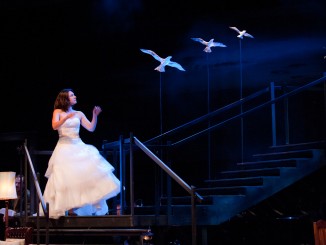
Poor Boy is a song written by kiwi music royalty Tim Finn and released in 1980 on Split Enz’s True Colours album. The lyrics ‘My love is alien, I picked her up by chance / She speaks to me in ultra-high frequency’ are apparently about a ‘poor boy’ who falls in love with an alien, who he can only hear through radio interference. Righty. It seems a strange choice then for this song to become the title and main musical theme of Poor Boy, a play that makes much use of Tim Finn’s music, about a man killed in a traffic accident who returns 7 years to the day of his death in the body of a 7 year old boy.  

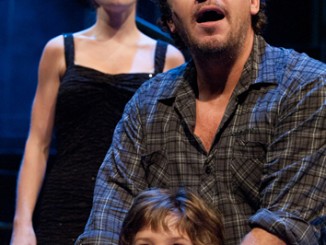
Poor Boy, the play, begins surreally. A tricycle moves seemingly by itself. A man walks in wearing a large Zebra mask. This is Danny (Roy Snow) the dead man who will inhabit the body of Boy (Finn McLachlan at my performance, who alternates the role with Mitchell Hageman). He sings the titular track in an almost low key way, the music never quite bursting into the full Split Enz version that we know. An intentional choice.

Poor Boy, a collaboration between playwright Matt Cameron and composer Tim Finn, had seasons in Melbourne and Sydney in 2009 where they apparently aimed to replicate closely the original versions of Finn’s songs, which include Into the Water, Ghost Girl and Unsinkable. In Auckland Theatre Company’s version, under director Raymond Hawthorne and Musical Director John Gibson, the songs and play have been re-jigged. Gibson’s versions adhere less strictly to the originals, a decision, along with removing the interval and tightening the play, I imagine strengthens the experience considerably (John Gibson says they felt the songs needed to be bought more into the world of the play), especially since the connections between some songs and plot is tenuous at best, though points for making Poor Boy’s thematic impossible love and radio references work.

21Mar/110

Radio Review! ATC’s Poor Boy

Lauren Porteous, Andrew Grainger and Finn McLachlan in POOR BOY.

My lovely theatre scenes co-reviewer Sharu Delilkan got on National Radio's Arts on Sunday to review Auckland Theatre Company's latest offering Poor Boy, featuring music by Tim Finn.

Find out what she told Lynn Freeman about the production here.

I'll be seeing the show on Tuesday, so will have a print review for Theatre Scenes post show.

I am very curious about this production. While it uses many of Tim Finn's hit songs, Sharu says it is not a musical, but rather theatre with song.  It has been performed in Melbourne and Sydney, and we are finally seeing it here.

Dionne Christian wrote an excellent primer in the NZ Herald for the production, which reveals director Raymond Hawthorne has taken a unique approach for the kiwi premiere.

- James.

18Mar/112

REVIEW: The Show Must Go On (Auckland Arts Festival)

Turning the tables [by Sharu Delilkan]

The Show Must Go On

Not your normal dance show

Of all this year’s festival shows The Show Must Go On has to be the most memorable.  Not for acting, lighting, staging, music, writing, dialogue (there is none) or dance, but the real and raw effect it has on the audience.

Descriptions such as ‘challenging’, ‘groundbreaking’, ‘brave’ and ‘provocative’ come to mind but I’ll try to refrain and just say that my mind was whirring at a million kms an hour trying to comprehend what I had just experienced, standing on the steps outside the Mercury Theatre after the show.

If you expect to sit back and have the actors on stage do all the work for you, The Show Must Go On is bound to surprise.

But if you’re there to be tested, something which the cult figure in the international dance world Jerome Bel is notorious for, you’re in for a treat if you get into the spirit of things.

17Mar/110

REVIEW: First Love (Auckland Arts Festival)

Beckett on Love [by Sharu Delilkan]

First Love Samuel Beckett

Love and Benches.

We were greeted by instrumental music that immediately made me reminisce with fondness about my first love. 

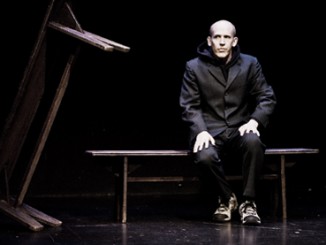
The stark stage with two different sized benches and the cold blue lighting contrasted the emotive background music.

It’s not long before Conor Lovett enters stage right dressed in a chequered suit, hoodie and worn reddish-brown leather shoes.  He loses no time telling us about his life which includes details of his separation and listlessness toward family.

Originally written in French in 1946 and translated into English by Samuel Beckett, First Love is a fabulous play on words that keeps the audience both mesmerised and in stitches throughout the 70-minute production.The language is dense and superb expressing depression and neglect with a razor sharp wit that creeps up on the audience almost as subtlety as the “love affair” he describes.

15Mar/112

FESTIVAL PREVIEW: Jerome Bel’s The Show Must Go On

Just Dance. [by James Wenley]

The Show Must Go on

Dance!

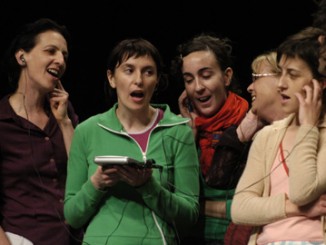
Before me, 19 performers dance to Reel 2 Real’s ‘I like to move it’. Some are dancers, some are actors, and some have never performed before. It’s not your standard dance choreography, and it is definitely not abstract. The song is being taken literally, each performer has a different ‘it’ that they like to move, and they sure move it! There are arms, shoulders, bums and other surprises. As the song continues, the actions get more manic. It’s quite unlike any dance piece I’ve seen before. It is one of the unexpectedly joyous numbers in Jerome Bel’s The Show Must Go On.

If you’ve noticed a drop off of the number of shows I’ve been able to go out and review on this blog, I do have a very good reason. I am the Show Must Go On’s ‘DJ’, the show’s glorified sound and lighting operator. Apparently they were looking for a professional techie, but because there is a super special dance solo involved, none were willing to put up their hands. So they’ve ended up with me. I’ll be sitting in front of the Mercury Theatre stage at a special desk doing the sound and lighting, and at one point, a little bit more.

The Show Must Go on was created by French Choreographer Jerome Bel and his original company 10 years ago. Since then, it has been performed around the world. In each city, a new local company made up of a mix of amateurs and professionals are taught and perform the show.

14Mar/111

Adieu Auckland Fringe

I hardly saw thee… [by James Wenley] 

Auckland Fringe Festival Awards

Fringey.

Last night the Auckland Fringe Festival closing night was partied away in exuberant style to a live Swing band, after the awards had been handed out, in the stunning Pacific Crystal Palace Spiegeltent in Aotea Square. The Spiegeltent was a ‘loan’, of sorts, from the Mumma Auckland Arts Festival. Whereas the prestigious Arts Festival (one week left!) provides for amazing local and international work on the larger stages, Auckland Fringe, over the last 2+ weeks, seems to have taken over every possible remaining venue (and non-venue) and delivered work that was intimate, thrilling and bafflingly unexpected. Auckland: We’ve got talent. 

Tim Balme, representing South Pacific Studios in handing out the Fringe performance awards, had the quote of the night – “Without Fringe there would be no edge, and with no edge, things would get soft in the middle”. Well, it seemed profound at the time. Mark Burlace from Mamma Festival said that the two festivals have “united this city”. Fringe Festivals the world over are one of the main training grounds for performing talent. Having so much other work on at the same time can be both a blessing and a curse, and you’ll quickly learn how to swim, and hopefully not sink (or at least move to the shallow end of the Parnell Baths!). 

14Mar/110

REVIEW: Standstill (Auckland Fringe)

All is revealed [by James Wenley]

Standstill

Too late!

With the Auckland Fringe over, it is safe to talk about Standstill. The latest from The Rebel Alliance, Standstill featured a unique and risky promotional campaign. Their image said “Don’t read this” and the promotional blurb told us nothing about what the show was about, or who was in it. We were asked to take a chance on a show that we knew nothing about.

And it seems to have worked. I must confess, I did have a sneaky look at some of the reviews that came out after the show’s first night. With Sunday being the last night of the Fringe, I had to make a difficult choice about what I would be able to see. So I took a peak. Do early reviews destroy the concept of the campaign? Perhaps. After reading them I was still intrigued, and even surer that this was a show I wanted to experience.

11Mar/110

REVIEW: The Manganiyar Seduction (Auckland Arts Festival)

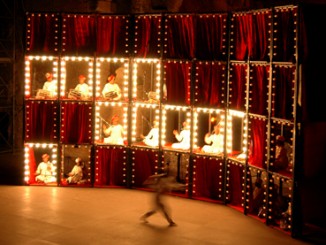
Think inside the square [by Sharu Delilkan]

The Manganiyar Seduction

Indian Celebrity Squares!

In the bar prior to the performance someone said “Are you ready for ‘Indian Celebrity Squares’?”. And that was exactly the structure of the musicians we were greeted with onstage, with nine musicians across by four storeys high, revealing a whole grid of musicians who were eventually collectively lit.

This was the beginning of The Manganiyar Seduction experience.

The visual was a little bit puzzling although we all knew that we were there to witness something that most of us had never seen before.

So with an open mind, I decided to let the evening unfold.

10Mar/110

REVIEW: Big Story, Small Space (Auckland Fringe)

Which genius lit the world? [by Sharu Delilkan]

Big Story, Small Space

Electrocution! Sabotage! Elephants?

As the audience pile into the ‘small space’ I couldn’t help thinking ‘How many more can you fit in?’.  But the constant stream keeps flowing and eventually the show’s co-writer and director Pip Smith bellows ‘I’ve added a chair at the end of that isle across the stage but can I make anyone else more comfortable by adding another chair?’. We nod profusely and say ‘yes please’, emphatically. I finally was able to exhale and begin settling in.

The Basement has basically been shrunk into a tiny space where there’s almost no delineation between actors and the audience who’re literally on top, around and between each other.

The tiny 2-m square stage in the middle is just sufficient for the actors to move around in – making us feel like we’re in the thick of the action – which I particularly liked.  I also enjoyed actors coming onto the stage from all four corners keeping everyone on their toes.  And the most interesting was when two of the actors had to clamber over people to get centre stage. The ‘small’ part of the billing gets a tick with the intimate setting that allows bombardment from all sides with dialogue, sound effects and cool lighting.