Theatre Scenes: Auckland Theatre Blog (Reviews, interviews and commentary)
16Jun/130

REVIEW: Anne Boleyn (Auckland Theatre Company)

The Other Woman [by James Wenley]

Anne Boleyn

Anna Jullienne as Anne Boleyn. Photo: Michael Smith

Boleyn comes encumbered by reputation. She’s called a great deal many things through the course of the play: “the harlot queen”, “intolerable woman”, “witch”, “the whore”. She’s arguably subject to one of history’s great hatchet jobs, the dangerous female who bewitched a King and tore England asunder. For his 2010 drama, Howard Brenton recasts and reclaims Anne as a tragic heroine who seeks to make her own place within the male-dominated factions of Henry VIII’s court, and by winning the King’s love, and the King’s ear, steers world history on a different course.

Brenton’s Anne, by way of Anna Julienne, is driven by a potency of burning ambition, higher ideal, changing-the-world zeal, and, yes, love.

Whereas Anne’s sister Mary succumbed to the King, and subsequently found herself out of favour, Anne knows the value of sex as tool. Anne catches Henry’s attention when she throws an orange at him during a court masque. There is a suggestion that what propels Henry’s interest is Anne’s decided delay in bearing all her fruits; a tortured Henry asks to see “a little further than the knee”. Seven years later, Anne and the King finally consummate their courtship. The King suggests this would be a good time for an interval.

The play is like that – there are serious weighty themes, not least the fierce battle for England’s religious soul, tied up with sexual bawdy and theatrical winks to the crowd. For this, Brenton takes his cue from Shakespeare’s mingling of high and low.

22Jul/120

REVIEW: Awatea (Auckland Theatre Company)

Awatea Shines Brightly [by Sharu Delilkan]

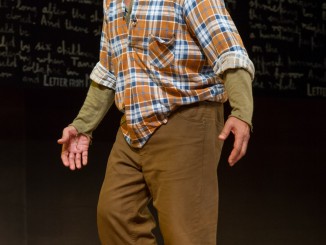
George Henare in Awatea. Photo by Michael Smith

You knew the writing was on the wall the minute you walked into the theatre. I’m of course referring to the beautifully chalked letters that 'panoramically' filled the backdrop of the entire stage. So dramatic, intriguing and utterly effective was this device that you could not help reading some of the letters while the show was going on.

But on to the show.

Having produced both The Pohutukawa Tree and The End Of The Golden Weather, Auckland Theatre Company’s production of Awatea completes Bruce Mason's classic trilogy of powerful New Zealand dramas. And it is everything it promises to be – thrilling, heart-wrenching, morally tough - a fiercely realistic study of betrayal and disillusionment.

Awatea, based in and around Ngati Porou country, is the story about a remote township of Omoana that revolves around their ‘hero’ Dr Matt Paku (Te Kohe Tuhaka) who left the East Coast and now owns a successful practice in Auckland. Proudest of all is his old, blind father Werihe (George Henare), who basks in this success via his son's letters, read to him by the no-nonsense local postmistress Emma Gilhooly (Geraldine Brophy). Every New Year's Eve, Matt comes home and the whole community celebrates. But things are different this year: Gilhooly has devastating news which she must keep from old Werihe at all costs.

7May/120

REVIEW: A Midsummer Night’s Dream (Auckland Theatre Company)

Fancy a Puck? [by James Wenley]

Puck's got Swagger

At the end of Shakespeare’s A Midsummer Night’s Dream, hobgoblin Puck famously excuses all that has gone before as a “weak and idle theme, no more yielding but a dream”. If so, it was a fantastic and crazy dream that the audience collectively dreamed in the theatre. While Puck undersells the thematic depths of the play, Auckland Theatre’s Company’s fast and furious streamlined show (no interval!) emphasises the fun and farce of love gone very, very wrong.

Midsummer Night’s Dream, though taking inspiration from several sources, is credited as being Shakespeare’s only original plot. It’s one of his most popular too – a comic plot that sees a love quadrangle of miss-matched Athenian youths Hermia, Helena, Lysander and Demetrius enter the woods, which also contains a group of amateur actors rehearsing a play for the wedding of Duke Theseus (Peter Daube) to his exotic bride Hippolyta (Goretti Chadwick), as well as being the home of mischievous fairies, reigned over by feuding lovers King Oberon (Xavier Horan) and Queen Titania (Alison Bruce).

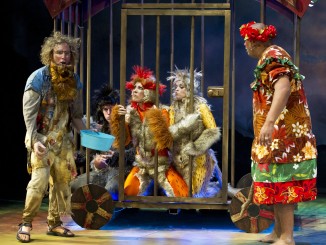
I wish my own dreams looked like this. An almost unbearably bright red raked stage looks out at us, a fittingly unbalanced playing space which at various times the actors climb, slide and leap off. No subtly here then – the red of fervent passion and desire dominates. The gloriously styled black and white fashions of the four lovers – including Brooke Williams’ Hermia school girl burlesque chic topped with  an upside-down cupcake tutu, and Josh McKenzie’s wrapped in a foppishly large bow tie and ankle high socks, take a bow designer Nic Smillie – gets considerably skimpier the longer the play goes on.  Goretti Chadwick’s Hippolyta, going against received interpretation, is rather into her Theseus. And there are enough bare-chested men to rival the wolf pack of the Twilight films.

30Apr/120

PREVIEW: A Midsummer Night’s Dream (Auckland Theatre Company)

In Love with Shakespeare [by Sharu Delilkan]

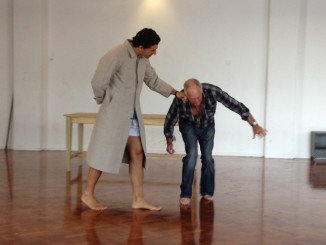
(L-R) Xavier Horan (Oberon) rehearsing with theatre stalwart Raymond Hawthorne (Puck)Photo by Edward Peni

It has been a journey of self-discovery for Xavier Horan, particularly since he has gone from being a ‘Shakespeare-phobe’ to acting in two of his plays within a matter of months.

Horan, who has recently performed at The Globe Theatre London in the ground breaking Maori production of Troilus and Cressida, is extremely excited about his role as Oberon in Auckland Theatre Company's latest production A Midsummer Night's Dream.

He is equally chuffed about being part of the 18-strong stellar cast which includes father daughter duo Stuart Devenie (Egeus) and Laurel Devenie (Helena) as well as Alison Bruce (Titania), Goretti Chadwick (Hippolyta), Peter Daube (Theseus), Andrew Grainger (Bottom), Raymond Hawthorne (Puck), Rima Te Wiata (Peter Quince) and Brooke Williams (Hermia).

A Midsummer Night's Dream features three interlocking plots, connected by a celebration of the wedding of Duke Theseus of Athens and the Amazon queen, Hippolyta, and set simultaneously in the woodland, and in the realm of Fairyland, under the light of the moon.

Horan admits that the whole Shakespeare experience was very scary at first, due to the fact that he was treading on unfamiliar territory. However he says working closely with veteran thespian Hawthorne has been his saving grace.

4Dec/110

REVIEW: The Twits (Auckland Theatre Company)

Nasty delights in an upside-down world [by James Wenley]

The Twits, Auckland Theatre Company

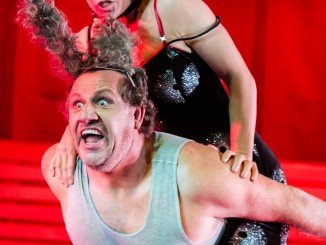
Te Radar and Dave Fane as The Twits. How these two got together we'll never know... Photography: Michael Smith

Roald Dahl has a lot to answer for. His childrens stories, among them Charlie and the Chocolate Factory, The BFG, and Fantastic Mr Fox are gruesome and subversive tales, in George’s Marvellous Medicine for example, 8 year old George is responsible for the death of his Grandmother (causing her to shrink into nothing). The adults in Dahl’s stories, like Boggis, Bunce and Bean in Mr Fox or Principal Trunchball in Matilda, are a mean and reprehensible lot.

 And with these wicked and whimsical stories, Dahl has been a champion for generations of children. His books were a constant presence during my childhood. Never talking down to or underestimating his readership, his works speak to the mind of a child growing up in a confusing world. Adults, as all children know, don’t always know best.

 In The Twits, Dahl introduced us to two of his most loathsome characters – Mr and Mrs Twit. Mr Twit eats weeks old food caught in his beard. We’re told Mrs Twit used to be beautiful, but after thinking years of “ugly thoughts”, her face turned ugly too (great message there).  The couple are always trying to play tricks on each other – their mutual hatred of each other seemingly  the only thing keeping them together. Add to this villainy Mr Twit’s slavery and abuse of a family of monkeys who he plans to train to perform in an upside-down circus, and the Twit’s desire to trap a flock of birds and cook them in a pie, and you have two outright despicable people!

For their final year show, and first Children’s show in a number of year, Auckland Theatre Company brings repulsive life to The Twits in the forms of Te Radar and David Fane (for who else would make an uglier woman?). Their disgusting habits and tricks – including a glass eye cocktail, and serving worms on spaghetti - earn big wicked laughs from the children in attendance. Like big kids themselves, the Twits tricks appeals to a child’s naughty side.

And as it turned out, this production appealed to the naughty side of a lot of adults too…

23Oct/110

REVIEW: A Thousand Hills (STAMP at THE EDGE)

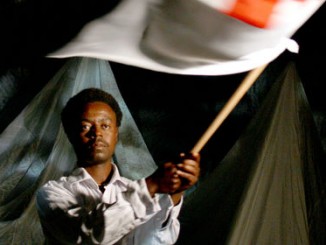
Francois Byamana waving the Red Cross flag

1,000 Reasons to see 1,000 Hills
[by Sharu Delilkan]

It is always a privilege and an honour to witness the premier of an original piece of theatre. But to be among the first to experience the personal sharing of a true story is even more significant. Naturally the foyer of the Herald Theatre was buzzing with eager anticipation when I arrived.

However given the subject matter I must admit I had the sinking feeling, in the back of my mind, that the work may be morbid, depressing and shocking in the spirit of the film Hotel Rwanda.

But those apprehensions were very soon cast aside as we were greeted by the pulsating sound of African drums when we entered the theatre. The music literally reverberated through our bodies and set the ambience for the evening. As others made their way to their seats I looked around me and noticed a number of regular theatregoers, who would ordinarily appear rather formal in their seats, moving to hypnotic beat of the drums. There was no denying the infectious music, both lively and joyous, had a definite impact on the audience – and was a sign of what was ahead.

14Aug/110

REVIEW: Calendar Girls (Auckland Theatre Company)

Tastefully titillating theatre [by Sharu Delilkan]

Calendar Girs

Ooo-er!

Leaving home yesterday evening on the way to the city to watch Auckland Theatre Company’s stage production of the infamous Calendar Girls brought its own set of surprises.

I innocently said to my mate who was giving me a ride to the city  “I’m going to Calendar Girls today”.  To which I got this euphoric response “Woo-hoo – I want to come too.”  It took me a split second to realise that she was not talking about Tim Firth’s play but was instead referring to the new establishment on K’Rd which is Auckland’s latest ‘gentlemen’s club’, billed as the city’s first five-star establishment of that genre.

I soon cleared up the miscommunication between chuckles and made my way to The Civic. 

Being opening night I was greeted by a sea of familiar faces.  Admittedly, having loved the movie of the same name, I was filled with anticipation as I entered the electric-charged theatre.

29Mar/110

REVIEW: Poor Boy (Auckland Theatre Company)

Oo hoo hoo hoo… [by James Wenley]

Poor Boy

Finn McLachlan and Rima Te Wiata

Poor Boy is a song written by kiwi music royalty Tim Finn and released in 1980 on Split Enz’s True Colours album. The lyrics ‘My love is alien, I picked her up by chance / She speaks to me in ultra-high frequency’ are apparently about a ‘poor boy’ who falls in love with an alien, who he can only hear through radio interference. Righty. It seems a strange choice then for this song to become the title and main musical theme of Poor Boy, a play that makes much use of Tim Finn’s music, about a man killed in a traffic accident who returns 7 years to the day of his death in the body of a 7 year old boy.  

Poor Boy, the play, begins surreally. A tricycle moves seemingly by itself. A man walks in wearing a large Zebra mask. This is Danny (Roy Snow) the dead man who will inhabit the body of Boy (Finn McLachlan at my performance, who alternates the role with Mitchell Hageman). He sings the titular track in an almost low key way, the music never quite bursting into the full Split Enz version that we know. An intentional choice.

Poor Boy, a collaboration between playwright Matt Cameron and composer Tim Finn, had seasons in Melbourne and Sydney in 2009 where they apparently aimed to replicate closely the original versions of Finn’s songs, which include Into the Water, Ghost Girl and Unsinkable. In Auckland Theatre Company’s version, under director Raymond Hawthorne and Musical Director John Gibson, the songs and play have been re-jigged. Gibson’s versions adhere less strictly to the originals, a decision, along with removing the interval and tightening the play, I imagine strengthens the experience considerably (John Gibson says they felt the songs needed to be bought more into the world of the play), especially since the connections between some songs and plot is tenuous at best, though points for making Poor Boy’s thematic impossible love and radio references work.