REVIEW: A Midsummer Night’s Dream (Auckland Theatre Company)
Fancy a Puck? [by James Wenley]
At the end of Shakespeare’s A Midsummer Night’s Dream, hobgoblin Puck famously excuses all that has gone before as a “weak and idle theme, no more yielding but a dream”. If so, it was a fantastic and crazy dream that the audience collectively dreamed in the theatre. While Puck undersells the thematic depths of the play, Auckland Theatre’s Company’s fast and furious streamlined show (no interval!) emphasises the fun and farce of love gone very, very wrong.
Midsummer Night’s Dream, though taking inspiration from several sources, is credited as being Shakespeare’s only original plot. It’s one of his most popular too – a comic plot that sees a love quadrangle of miss-matched Athenian youths Hermia, Helena, Lysander and Demetrius enter the woods, which also contains a group of amateur actors rehearsing a play for the wedding of Duke Theseus (Peter Daube) to his exotic bride Hippolyta (Goretti Chadwick), as well as being the home of mischievous fairies, reigned over by feuding lovers King Oberon (Xavier Horan) and Queen Titania (Alison Bruce).
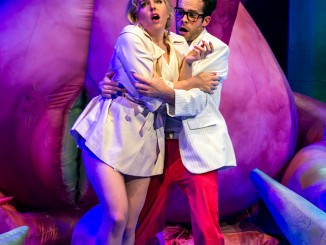
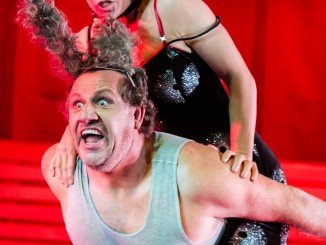
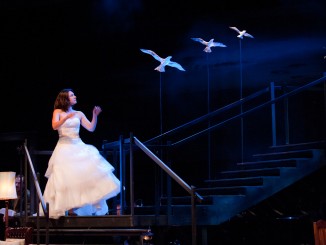
I wish my own dreams looked like this. An almost unbearably bright red raked stage looks out at us, a fittingly unbalanced playing space which at various times the actors climb, slide and leap off. No subtly here then – the red of fervent passion and desire dominates. The gloriously styled black and white fashions of the four lovers – including Brooke Williams’ Hermia school girl burlesque chic topped with an upside-down cupcake tutu, and Josh McKenzie’s wrapped in a foppishly large bow tie and ankle high socks, take a bow designer Nic Smillie – gets considerably skimpier the longer the play goes on. Goretti Chadwick’s Hippolyta, going against received interpretation, is rather into her Theseus. And there are enough bare-chested men to rival the wolf pack of the Twilight films.
PREVIEW: A Midsummer Night’s Dream (Auckland Theatre Company)
In Love with Shakespeare [by Sharu Delilkan]

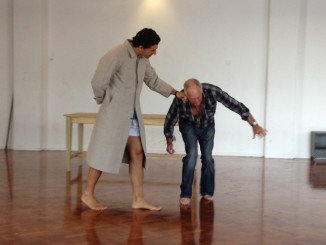
(L-R) Xavier Horan (Oberon) rehearsing with theatre stalwart Raymond Hawthorne (Puck)Photo by Edward Peni
It has been a journey of self-discovery for Xavier Horan, particularly since he has gone from being a ‘Shakespeare-phobe’ to acting in two of his plays within a matter of months.
Horan, who has recently performed at The Globe Theatre London in the ground breaking Maori production of Troilus and Cressida, is extremely excited about his role as Oberon in Auckland Theatre Company's latest production A Midsummer Night's Dream.
He is equally chuffed about being part of the 18-strong stellar cast which includes father daughter duo Stuart Devenie (Egeus) and Laurel Devenie (Helena) as well as Alison Bruce (Titania), Goretti Chadwick (Hippolyta), Peter Daube (Theseus), Andrew Grainger (Bottom), Raymond Hawthorne (Puck), Rima Te Wiata (Peter Quince) and Brooke Williams (Hermia).
A Midsummer Night's Dream features three interlocking plots, connected by a celebration of the wedding of Duke Theseus of Athens and the Amazon queen, Hippolyta, and set simultaneously in the woodland, and in the realm of Fairyland, under the light of the moon.
Horan admits that the whole Shakespeare experience was very scary at first, due to the fact that he was treading on unfamiliar territory. However he says working closely with veteran thespian Hawthorne has been his saving grace.
REVIEW: Top Girls (Silo)
You Can Be a Successful Woman, Too! (Terms and Conditions Apply) [by Rosabel Tan]
When people talk about women having careers, there’s a trade-off implied: You can’t have a career and a family – one will suffer if you try, and if you pursue the former, you’re defeminised: there’s something wrong with you or, at the very least, your womb.
Society has come far to ensure that this is a trade-off we can make, but it’s clear we have a long way to go and it’s this position that Silo explores in Caryl Churchill’s Top Girls. Divided into three acts, the play opens with Marlene (Danielle Cormack) celebrating her recent promotion to managing director with an eclectic and incredible bunch of women from history: There’s Isabella Bird (Bronwyn Bradley) a nineteenth century explorer and writer, Lady Nijo (Nancy Brunning), a thirteenth century concubine to the Japanese emperor, Dull Gret (Sophie Hambleton), the painted figure who led an army of women to Hell, Patient Griselda (Rachel Forman), whose obedience was the centre of many a fourteenth century tale, and Pope Joan (Rima Te Wiata), who rose to her seat by masquerading as a man.
REVIEW: Calendar Girls (Auckland Theatre Company)
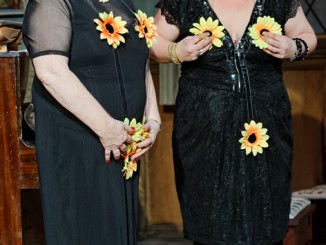
Tastefully titillating theatre [by Sharu Delilkan]
Leaving home yesterday evening on the way to the city to watch Auckland Theatre Company’s stage production of the infamous Calendar Girls brought its own set of surprises.
I innocently said to my mate who was giving me a ride to the city “I’m going to Calendar Girls today”. To which I got this euphoric response “Woo-hoo – I want to come too.” It took me a split second to realise that she was not talking about Tim Firth’s play but was instead referring to the new establishment on K’Rd which is Auckland’s latest ‘gentlemen’s club’, billed as the city’s first five-star establishment of that genre.
I soon cleared up the miscommunication between chuckles and made my way to The Civic.
Being opening night I was greeted by a sea of familiar faces. Admittedly, having loved the movie of the same name, I was filled with anticipation as I entered the electric-charged theatre.
REVIEW: Poor Boy (Auckland Theatre Company)
Oo hoo hoo hoo… [by James Wenley]
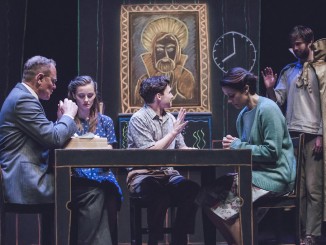
Poor Boy is a song written by kiwi music royalty Tim Finn and released in 1980 on Split Enz’s True Colours album. The lyrics ‘My love is alien, I picked her up by chance / She speaks to me in ultra-high frequency’ are apparently about a ‘poor boy’ who falls in love with an alien, who he can only hear through radio interference. Righty. It seems a strange choice then for this song to become the title and main musical theme of Poor Boy, a play that makes much use of Tim Finn’s music, about a man killed in a traffic accident who returns 7 years to the day of his death in the body of a 7 year old boy.
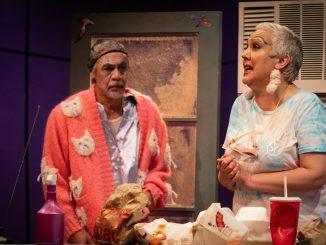
Poor Boy, the play, begins surreally. A tricycle moves seemingly by itself. A man walks in wearing a large Zebra mask. This is Danny (Roy Snow) the dead man who will inhabit the body of Boy (Finn McLachlan at my performance, who alternates the role with Mitchell Hageman). He sings the titular track in an almost low key way, the music never quite bursting into the full Split Enz version that we know. An intentional choice.
Poor Boy, a collaboration between playwright Matt Cameron and composer Tim Finn, had seasons in Melbourne and Sydney in 2009 where they apparently aimed to replicate closely the original versions of Finn’s songs, which include Into the Water, Ghost Girl and Unsinkable. In Auckland Theatre Company’s version, under director Raymond Hawthorne and Musical Director John Gibson, the songs and play have been re-jigged. Gibson’s versions adhere less strictly to the originals, a decision, along with removing the interval and tightening the play, I imagine strengthens the experience considerably (John Gibson says they felt the songs needed to be bought more into the world of the play), especially since the connections between some songs and plot is tenuous at best, though points for making Poor Boy’s thematic impossible love and radio references work.