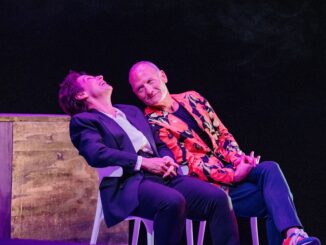
REVIEW: Private Lives (Silo)
My love-hate relationship with Silo’s Private Lives [by James Wenley]
Consider this plot: A newly remarried man about town books into a hotel room for his honeymoon only to discover that his ex-wife has booked the very next room for her own honeymoon. Will old sparks be reflamed? And what about their new partners? Hijinks and hilarity ensue.
Sure sounds like a plot from a cookie-cutter romantic comedy. Get Justin Timberlake and Mila Kunis to star. We’ll call it ‘The Honeymoon’. Print that money.
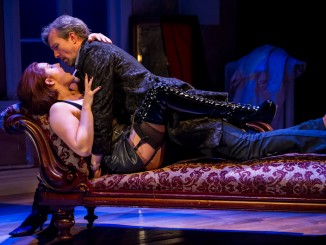
Theatre buffs like you know will know that this is in fact the plot of perennial favourite Private Lives by Noel Coward. Scandalous on its 1930 debut, director Shane Bosher, with a few cosmetic changes has thrust this comedy of bad manners into a raucous and sexy contemporary set version.
Matt Whelan and Mia Blake are the warring, chemically volatile ex-lovers Elyot Chase and Amanda Prynne, and it is their love-hate relationship that makes the play so delicious. It’s a dynamic that has provided good drama for centuries, and Coward’s dry wit is saturated with acid. Sighting each other on the hotel balcony they are aghast, but they are inevitably pulled back into their old romantic hurricane.
PREVIEW: The Pride (Silo)
A matter of pride [by Sharu Delilkan]
A heterosexual woman at the helm of a thrilling contemporary narrative predominantly focussed on the gay issues could have been a point of concern. But nothing could be further from the truth when it comes to Sophie Roberts' role as director for The Pride.
Her history of working on productions with gay themes has made her role in The Pride a natural progression in her career.
“I have done quite a few gay-oriented plays so I am quite comfortable dealing with those issues. I also like working with or highlighting the perspective of people on the fringes of society. I find such work more interesting and enjoy working in that territory. I strongly believe that theatre has a social and political function, which is why I seek out work that talks about these issues. And the fact that the gay marriage bill coming up in parliament gives the content of the play a lot more weight and relevance,” she says.
REVIEW: Tribes (Silo)
Now how to express my experience? [by James Wenley]
Tribes comes to Auckland’s stage with a babble of hype and expectation. Only playwright Nina Raine’s second play (after Rabbit which Silo performed in 2008 ), it’s something of an international critical darling after its debut at London’s Royal Court in 2010. Just last week it won New York Drama Desk’s Outstanding play award. So no question it would be good then, but just how much. Answer? Very good indeed.
One of the titular tribes in the play are a family (unencumbered by surname) an internally-warring yet deeply self-protective family made up of Dad Christopher (Michael Hurst), Mother Beth (Catherine Wilken), boomerang twenty-something kids Daniel (Emmett Skilton) and Ruth (Fern Sutherland), and youngest Billy (Leon Wadham) who, while being careful not define him as such, is deaf. The family have proudly bought him up in a ‘speaking’ environment, getting by with hearing aids and lip reading (a painfully slow learning process, credit to Mum).
This family’s default mode of communication, summed up by Christopher is: “Join in, have an argument”. Tribes launches us into a noisy family dinner; everyone speaking over the top of each other, getting their two cents in. It’s a revealing mixture of affection, annoyance and mocking that close familiarity breeds, and a very recognisable family dynamic indeed. But everyone? Billy, watching, processing, becomes my figure of attention, for the family are all but ignoring him. He says little, save for an odd “What are you talking about?”.
PREVIEW: Tribes (Silo)
Rejoining the tribe [by Sharu Delilkan]
Although it has been almost four years since her Silo debut, Fern Sutherland still remembers the experience as if it were yesterday.
"It was my first gig out of [UNITEC] drama school and I was extremely nervous when I met Shane [Bosher]. I felt very insecure and was desperate to make a good impression," she admits.
That's when she played an old woman in Life is a Dream working with Bosher, who's directing Silo's latest show Tribes.
However in Tribes, playing Ruth the middle child of a bohemian, intellectual upper-middle-class British family, the 24-year-old Sutherland says she feels slightly more at ease and able to enjoy the process.
REVIEW: Top Girls (Silo)
You Can Be a Successful Woman, Too! (Terms and Conditions Apply) [by Rosabel Tan]
When people talk about women having careers, there’s a trade-off implied: You can’t have a career and a family – one will suffer if you try, and if you pursue the former, you’re defeminised: there’s something wrong with you or, at the very least, your womb.
Society has come far to ensure that this is a trade-off we can make, but it’s clear we have a long way to go and it’s this position that Silo explores in Caryl Churchill’s Top Girls. Divided into three acts, the play opens with Marlene (Danielle Cormack) celebrating her recent promotion to managing director with an eclectic and incredible bunch of women from history: There’s Isabella Bird (Bronwyn Bradley) a nineteenth century explorer and writer, Lady Nijo (Nancy Brunning), a thirteenth century concubine to the Japanese emperor, Dull Gret (Sophie Hambleton), the painted figure who led an army of women to Hell, Patient Griselda (Rachel Forman), whose obedience was the centre of many a fourteenth century tale, and Pope Joan (Rima Te Wiata), who rose to her seat by masquerading as a man.
REVIEW: Tartuffe (Silo Theatre)
Tartuffe for the 3D Generation [by James Wenley]
If nothing else, Tartuffe is an experience.
‘This is not museum theatre’, warns/promises Silo Theatre in their bus shelter ads around town.
I’m curious about what their definition is, because I certainly don’t feel like Auckland is ‘afflicted’ by productions of this type. Professional Shakespeare’s in period dress for example are the rare exception, not the norm. Museum theatre suggests old, creaky, irrelevant (and I’m sure modern Museums themselves would have something to say against this!).
Silo’s Tartuffe does everything it can to show that its production of the 17th Century play is still edgy, fresh and up-to-the-minute with contemporary Auckland’s high society. Within the first minute we are treated to a real assault on our senses: funky music, garish neon flashing lighting, not to mention the sight of Cameron Rhodes in drag (nice legs). Sophie Henderson is ‘eaten out’, and a turd ends up in the Swimming pool. Yes, a turd. Museum Theatre? Couldn’t be more fresh.
REVIEW: The Only Child (Silo Theatre)
Not your classic ‘bathroom’ drama [by James Wenley]
In The Only Child, actor Stephen Lovatt spends most of his time in the bath.
If this sounds like taking it easy as an actor, it is anything but. From the bathtub Lovatt, naked - physically and emotionally, delivers an intense performance as a father dealing with profound loss, grief and, most harrowing of all, guilt.
It is a standout performance amongst an already impressive cast of Claire Chitham, Josephine Davison and Sam Snedden. Easily deserving of the ‘Best Actor in a bathtub’ award, I’d venture further to call it the performance of the year. He is one of many good reasons to see this production.
The Only Child was adapted by rising Australian auteur Simon Stone from Little Eyolf, one of Henrik Ibsen’s lesser performed works, written in 1894. Stone, 26, has created a name for himself with bold, sometimes controversial modern revisionist works of theatre classics and pushing theatrical boundaries. For his version of The Wildest Duck he placed his actors in a glass box, unable to see their audience. For its New Zealand debut, The Only Child is fittingly directed by Shane Bosher and presented by Silo Theatre who this year especially (excepting perhaps that Vodka show) have refreshed themselves and really delivered potent and exciting theatre in The Brothers Size and I love you Bro.
REVIEW: The Brothers Size (Silo Theatre)
Brooding tale of Brotherhood [by James Wenley]
The Brothers Size is a play that ignites the senses.
Playwright Tarell Alvin McCraney has been burdened with all sorts of praise, the voice of his generation, the savior of American theatre. He grew up in Miami’s deprived Liberty City housing projects, and has worked with such prestigious theatrical institutions as the Royal Shakespeare Company and the Steppenwolf Theatre Company.
What he does isn’t anything new, he uses a potent mix of the language of now – the language of the street, hip hop – to tell a universal story in an engaging way. That this play is receiving plaudits in an Auckland production by Silo Theatre is a testament to that. Good storytelling wins.
On a strictly narrative point A to point B level, the tale is a simple one. It’s about two brothers and what unites and divides them. Oshoosi Size (Pua Magasiva) is the ‘black sheep’, released from prison and taken into the care of head-to-the-ground elder brother Ogun (Jarod Rawiri), who tries to instill the value of hard-work and get him back on the right path. The presence of ex-con Elegba (Te Kohe Tuhaka), who ‘looked after’ Oshoosi while he was in prison, threatens to disturb the Size brotherhood.
Underneath this story are biblical and mythical echoes. McCraney has layered the story with elements of the West African Yorùbán Mythology – Ogun, for example, is the name of the God of Iron, Creativity and Violence, adding deeper metaphoric elements.
PREVIEW: The Brothers Size (Silo Theatre)
Jarod Rawiri sizes up latest role [by Sharu Delilkan]
Jarod Rawiri has taken to the ‘ghetto lingo’ of Boston like a duck to water.
He plays Ogun Size, one of the three main characters in Silo Theatre’s latest production The Brothers Size.
Rawiri says he has really enjoyed creating the movement for the vocabulary, which he says “has almost become second nature to me.
“Having worked in Red Leap Theatre’s The Arrival has really helped me with this part of my role.”
Another interesting part of being involved in The Silo production has been discovering the West African myths that form the backbone of his character Ogun’s ethnic history.
INTERVIEW: Shane Bosher on ‘Did I Believe It?’ and Silo Theatre’s 2011 Season + Ticket Giveaway(!)
“If our audience leaves the theatre and the first thing they say is ‘where are the car keys’ then we haven’t done our job.” [by James Wenley]
TICKET GIVEAWAY: I have a double pass to give away for the opening night of Silo Theatre’s first production of the year ‘Did I believe it’ on Saturday 9th April . Details at the end of this article.
Shane Bosher admits he would make a dreadful lawyer “and even worse mechanic”. Good thing then he is the Artistic Director of Auckland’s Silo Theatre Company, a position he has held since 2002, and seems rather quite good at it – turning the company into a theatre force to be reckoned with, and overseeing a number of memorable productions both at the former Silo Theatre space (now known as the Basement) and their new home in The Herald Theatre since 2008.
This year, Shane and the company are embarking on a series of genre busting plays under the season tagline ‘exploded narratives’. These include reimaginings of classicists Ibsen and Moliere, as well as brand new work and a sort of ‘hip hop’ play. The year will see Silo performing at the Herald Theatre and the new Q Theatre, but first up, Silo have teamed up with 42 Below Vodka and are performing, unusually, in a bar.
That play is Did I believe it?, directed by Oliver Driver and written with Jodie Molloy, who Shane says is “responsible for pulling all the dramaturgical strands together and being a bit of a joke doctor, which she’s done on things like the Jacqui Brown diaries and basically anything that Jeremy Wells has ever made”. It stars Toni Potter, Adam Gardiner, Brett O’Gorman and Dean O’Gorman
Oliver Driver had the initial inspiration a number of years ago when he was running Auckland Theatre Company’s 2nd Unit Development program. Together with Frith Walker, now Silo Theatre’s Executive Producer, they would go into clubs and wonder why they never saw these types of people at the theatre. Oliver devised a play with emerging actors about one night in the city, and gave tickets away to people in clubs, who ended up coming to the theatre over the course of the season. The process was repeated the following year and would become the basis of Silo Theatre’s Ensemble Project.
It was a night at the bar last year that Shane and Oliver began to solidify the idea for Did I believe it? Shane continues the story: