Theatre Scenes: Auckland Theatre Blog (Reviews, interviews and commentary)
30May/130

REVIEW: Gravity Hotel (The Basement)

Mass Appeal [by Matt Baker]

Gravity Hotel

Gravity Hotel

The less said about Gravity Hotel, the better. I say this, not in regards to the incredibly high quality of the work, but of its journey, as it is one that simply must be experienced as opposed to explained. Very rarely does an audience remain seated post show in huddled discussion about the events they’ve just witnessed, but such was the case on the opening night of this unparalleled production.

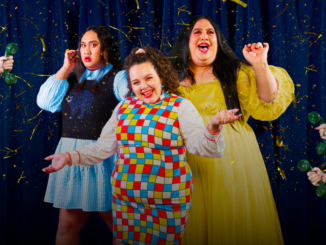
Actress Julia Croft arrives, post trauma, at the titular hotel, manned by the ‘Triplets of Bellevue’ style singing staff, consisting of Renee Lyons, Kate Bartlett, and Lisa Greenfield, as maid, cook, and bellhop respectively. Croft is a remarkably watchable actress, which works in her favour as we experience the oddities of the hotel as she does, with minimal dialogue, but a great amount of internal and external drive to support her.

Lyons brings an hilarious vivacity to the show, and shifts between extremities with clear thought processes and strong actions. Bartlett, likewise, brings her stories to life, albeit in a more subdued, yet equally resonant, way. Greenfield, however, seems to have put on her character externally, as opposed to finding her physicality from within. Combined with her showy facials, oddly pitched line delivery, and accent, I would be left at a general loss as to her character if not for the ironic clarity the script retrospectively provides.

29Apr/130

REVIEW: David Ladderman in Battle of the Bastards (Comedy Festival)

A show worth fighting for [by Matt Baker]

Edmund's Comedy Show: Stand-up for Bastards

Starting nearly half an hour late can result in an immediate uphill battle for a performer, but, with an enthusiastic energy and true showmanship, David Ladderman quickly has us on his side in his one-man show Battle of the Bastards. The show focuses on the sub-plot to King Lear, namely, the events surrounding Gloucester, Edgar, and Edmund, as initiated by a letter from the latter. Ladderman incorporates the letter motif nicely both in content and style, and addresses and performs the key scenarios they incur.

A few other props, the style element of which Ladderman humoursly addresses, add to the simple spectacle element of the show, which includes a good use of side-lighting to capture the physicality of the performance. There’s some audience participation, and although some of the more vocal audience members didn’t know when to stop, Ladderman took it all in stride and pushed through for a great-paced 50 minute show.

15Mar/130

REVIEW: And I Was Like (The Basement)

And I Was Like: Whatever [by Matt Baker]

And I was Like

You could say Eli's performance was muted...

In his programme notes, writer and director Sam Brooks puts forth the question, ‘What happens  when you take one of the fundamental pillars of relationships, the words, out of the equation?’ He  summarises by saying that ‘when it gets from the stage to your faces, maybe you’ll get your  answer.’ If there is an answer to be found in this play, it is a bleak one.

The premise itself has promise, but the show inevitably fails in its execution of it. It focuses on  relationship dynamics, but presents them as nothing more than selfish and ugly. When Philip falls in love with Trace, who is mute, his closest friend, Christine, tells him he is making a mistake. Why? Because she doesn’t want to see him get hurt. Yet there is no reason to believe this will happen so early on in the piece. Trace’s sister chastises both of them. Even Trace himself seems completely nonchalant towards Philip. Silence is one thing, but Trace is actually closed off. We’re told of how and when he stopped talking, but it’s such an inconsequential and boring story. The why is never explained, so why are we meant to care as an audience? Either the reason should be extreme, or it should be left completely unknown to the audience. There’s a room in Trace’s apartment, which remains locked to Philip, it’s symbolic, but it also remains locked to us. Similarly, and without giving the ending away, if Trace ever does choose to speak, he has to have a very good reason to do so. If he doesn’t, we need to have at least some clues as to why. Audiences don’t need answers, but they do require questions to be raised without complete ambiguity.

1Mar/130

REVIEW: La Vie dans une Marionette (Auckland Fringe)

Joie de vivre [by James Wenley]

La Vie Dans

White Face!

It is strange at first to see performers Tama Jarman, Justin Haiu and Jarod Rawiri in the white face, white gloves, and the exaggerated clothing of a mime artist. While the art of mime, along with clowning, is typically taught as a module in drama training, and while it informs a lot of local acting or physical theatre (see Red Leap’s The Arrival), it is rare to see the full white face kit, and we can’t initially take them very seriously. But neither do they: the White face gives them permission to be cheeky and a little bit juvenile, with hilarious mimed gags and more.  Rawiri, the only one of the three to consistently speak, tells us (in a French accent) that we will not be seeing awesome French theatre, because they are not French. What the kiwi sensibility seems to add to the mix is a whole lot of added cheekiness. We lap up the hilarity, but the magic of La Vie Dans une Marionette is when we start to care.

La Vie Dans has been in on-and-off development since the original ten minute version won the Wild Card Award at Auckland’s first Short+Sweet Theatre Festival in 2010. A summary of this new expanded version can still be kept quite short: a solitary piano player (Jarman) is delivered a box which contains a life-size marionette (Justin Haiu).  When he cuts the marionette’s strings, the pianist discovers it can come to life of its own accord whenever he plays his piano or a music box. Wisely, they don’t try to pack a lot it into the story. It is simple and strong, allowing extended gags to be developed, and for us to admire the physical prowess of the actors.

25Feb/130

REVIEW: Elevator (Auckland Fringe)

Catharsis of the Confessional [by Matt Baker]

Elevator

Don't get trapped in an elevator with these 3 women.

3 women trapped in an elevator. It’s a simple yet possibility problematic premise, however, Jess Sayer’s script, as reflected in her writer’s notes, finds freedom within structure, and, consequentially, an incredibly engaging story.

Sayer’s razor sharp wit is acutely vocalised by not only herself, but also by fellow actresses Michele Hine and Lauren Gibson. The combination of Sayer’s vulnerability, Hine’s protective nature, and Gibson’s sardonic attitude makes for what, at first glance, may seem a tedious dynamic, but the sequences of constriction and release within the text allows for a great amount of variety for these actresses to play.

25Feb/130

REVIEW: Celery Stories (Auckland Fringe)

Anarchic Fairy Tales in the Dark [by James Wenley]

The Singing Prince (Jordan Mooney)

At the same time as the Lantern Festival lit up Albert Park, Myers Park came to life in quite a different way as a procession of Fairytale characters and creatures prowled its grounds. Myers Park has been associated with Auckland Fringe since the Festival’s original launch in 2009 and has played a part in reclaiming the park – often avoided – for the public. Inheriting the Myers Park mantle from 2011’s When Animals Dream of Sheep, Celery Productions’ Ella Mizrahi and Celia Harrison (the brains behind Ponsonby Park’s popular Art in the Dark) have teamed with collaborators from The Basement theatre to produce promenade theatre Celery Stories which is at times magical, gleeful, anarchic, and frustrating.

We gather at the St Kevin’s Arcade entrance to Myers Park where we are hepfully sprayed for the “giant” mosquitoes that lurk below. After a wait, Bruce Hopkins, wearing a muscle-chest suit, announces himself. He reads us a ‘Once upon a time’ story about a “merry band of travelers” who ventured into a strange world (that at times felt like they had partaken of the “electric pooha”) and faced encounters with characters like a lone and mischievous piper, seven short and hairy men, and a red-hooded “waif”. We would of course meet them all – and more – in our own journey through Myers Park to The Basement Theatre, and this time-honoured story device is a welcome way of putting what we are about to see in some sort of context. Hopkins warns that “survival is the order of the night” before shouting for us to “make haste” as we go down the arcade stairs. Our first encounter is a portent of doom: a maniacal face projected onto a large tree, moving as if the tree’s leaves itself were in motion; there are cries of recognition and surprise as audiences sight the face. It pays to keep your eyes open on this adventure.

22Feb/130

REVIEW: Dolly Mixture (Auckland Fringe)

Gross-out Dolly Horror [by James Wenley]

Dolly Mixture

Who is creepier?

Thomas Sainsbury and Yvette Parsons’s previous work together typically tend to features unsavory oddballs, extracting comedy from social awkwardness and character eccentricities. This style is once again at play in Dolly Mixture in which the premise sees Crispin Merriweather (Sainsbury) boarding at the residence of Beverly Beavington (Parsons) who restores dolls as her hobby. But Beavington has a larger restoration project in mind. While Mixture is billed as a ‘horror comedy’, here the comedy is only a brief respite to the tension, horror and truly gross-out moments. Dolly Mixture is arguably Sainsbury’s and Parson’s sickness work yet, experimenting with how much they can get away with.

Beverly Beavington’s world is a mix of olive floral patterns, kitsch, the gothic, and faded glory: her living room’s centerpiece is a shelf filled with curious looking dolls in various states of disrepair which stare out directly to the audience and manage to look genuinely creepy. The dolls aside, the play’s aesthetic creates a palpable feeling of unease. Little things just aren’t right: Sainsbury’s bold purple suit is ill-fitting, and he keeps his backpack on the entire time, never comfortable.  Parsons’s Beavington is unnerving: smudged lipstick, rotting teeth and black eye contacts which make her look uncannily like one of her own Dolls.

22Feb/130

REVIEW: Tim Dibley. Masterclass (Auckland Fringe)

Christ knows he should be charging a lot more [by Matt Baker]

The well-known face of Mr Tim Dibley, Casting Director.

After three years of gradually and increasingly leaking the persona of Tim Dibley into the acting community’s collective consciousness, actor and casting director Eryn Wilson has finally taken the step from Facebook and Youtube to the stage in the premiere live performance of his ridiculous yet somewhat veracious alter-ego. Billed as a masterclass for actors, Dibley takes the audience through a sequence of acting exercises and audition techniques, taking a series of comedic no holds barred swipes at both general concepts and individuals within the industry. While some of the person-specific jabs will undoubtedly be lost on those outside the business, they can rest assured that Wilson successfully avoids any hint of maliciousness, laughing at himself as much as (if not, more so than) others.

Audience participation is an integral part of the show (be sure to get your photo taken as you enter the theatre space), and I would encourage those who initially find that idea aversive to be open to the safety of both Wilson’s and Dibley’s professionalism. It truly makes the show unique, and is a testament to Wilson’s acerbic wit and improvisational skills.

18Feb/130

This Week in the Theatre Scene: Make The Basement your new home (18-23 Feb)

This Week’s Picks: Black Faggot, Elevator, A Night to Dismember and Dolly Mixture [by James Wenley]

Auckland Fringe is out in full force from this week, and audiences are  spoilt for choice, you lucky things you. All of our picks are at The Basement this week, giving you the perfect opportunity to check out their classy new bar area.

PICK ONE

Black Faggot

PICK ONE: Black Faggot

The Show?  Black Faggot
Who Wrote it? One our best: Victor Rodger.
Who’s putting it on?  Multinesia, Roy Ward directs.  The show is doing both Auckland Fringe and Auckland Pride Festival, the dirty two-timer!
What’s it about? “A series of (mostly) humorous monologues from a vast array of (mostly) gay Samoan characters”
Who’s in it? Sione Wedding’s Iaheto Ah Hi and Shortland Street’s Beulah Koale  who play many different characters.
Pithy Theatre Scenes review Quote: "It’s a sad fact that the people who should see this show the most, are the ones who probably won’t." (It's all in the title)
Where? The Basement. 8:30pm tonight till Wednesday 20th, 8:30pm.
Tickets? $15-$20 at iTICKET

17Feb/130

REVIEW: A Night to Dismember (Auckland Fringe)

Dexterous “Big Fish” Yarn [by James Wenley]

Its not safe when Wil Greenway is in the water

A Night to Dismember by Australian creator and performer Wil Greenway is a late Fringe entry that handily plugged a gap in The Basement’s schedule after previously advertised Truth was cancelled. Hopping across the ditch after seasons in Adelaide and Melbourne, Dismember has a true Aussie larrikin spirit and an off-beat sensibility that is worth seeking out.

The show is performed solely by Greenway, who is a mix of sensitive artist and an unmanscaped shell (the press release calls him a “hairy idiot”). He wears bare feet, a blue shirt and shorts, and a poncho with a cartoon picture of a shark, which he uses this hide his arms, and is a bit of a silly sight.

On first appearances the whole thing seems quite fantastical – Greenway’s character loses both his arms after two separate incidents with the same shark, loses his girlfriend Liz, befriends an asteroid named Jerry, goes bush with a legless man named Filthy Kevin, and so on. It’s a “big fish” story that keeps expanding in its vivid ridiculousness. It remains however unconvoluted, and one of the big factors that makes this story work is that it retains its own inner logic, and keeps returning to events and characters already setup.