Theatre Scenes: Auckland Theatre Blog (Reviews, interviews and commentary)
19Apr/130

REVIEW: Madame Butterfly (NZ Opera)

Colourful Culture Clash [by Sharu Delilkan]

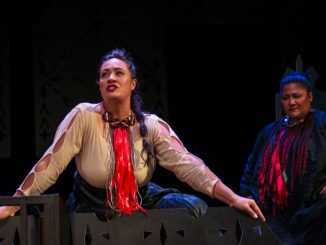
Cio-Cio San aka Madame Butterfly (Antoinette Halloran) reprimanding Suzuki (Lucy Schaufer) for point out painful truths. Photo: Neil Mackenzie

We were welcomed to the opening night of Madame Butterfly by The Edge’s Director Robbie Macrae, billed as the grand opening of the newly refurbished ASB Theatre with improved decor and acoustics.

Having seen Madame Butterfly more than a decade before in Hong Kong we were intrigued to see how an American-Asian love story would play in an Anglo-Saxon country.

The story of Madame Butterfly follows an ‘oh so familiar’ theme – one we saw repeated over and over again in Asia whereby a handsome European (Gwai Lo) charms a young, beautiful Asian girl into a relationship – both have different hopes, desires and cultural values that ultimately tear them apart. As with many of the Pakeha in Asia that ‘went native’ – a large proportion struggled to maintain their ‘love’ when it was time to head back to the motherland and often the besotted and flattered young girl was literally left holding the baby while the ‘husband’ goes home to his white ways and often back to his unsuspecting white wife. The difference in cultural realisation of respect i.e. face and bringing shame to the family are and have never been fully understood leading to tragic circumstances. Giacomo Puccini’s portrayal of these events still has relevance today, and I still recall how many people in the audience of the Hong Kong version ironically comprised of older Pakeha guys holding hands with their Asian girlfriends less than half their age.

29Dec/110

Looking Back: 2011 – A Theatrical year in Review

Q opens in triumph, Fringe overshadows Festival, Outfit Rise, Rugby, Rugby, Rugby, and the Death of the Theatre. [by James Wenley]

As 2011 comes to an end, Auckland theatre finds itself in rude health

Attending the recent Hackman Theatre awards, Auckland Theatre circa 2011 would appear to be in rude health. Rude being the word, hosts Nic Sampson and Joseph Moore proudly observing it was a record year of nudity on stage, from the very brave Mr. Sam Seddon in The Only Child to the Dame bosoms of the Calendar Girls. It was certainly year that didn’t leave much to the imagination, containing everything from dildos to knitted phalluses, bath tubs to swimming pools.

The Hackmans were a big communal pat on the back for the industry, a brash and bold celebration of a huge year in theatre. As Jennifer Ward-Lealand and Robyn Malcom closed the awards night performing in a Thomas Sainsbury play that he had written under duress that very night, there was a sense that anything and everything was possible.

As a critic moving from Craccum to my own Theatre Scenes blog this year, I’ve welcomed the end-of-year theatre break. Throughout the year, I could often be heard to exclaim: ‘Auckland Theatre: There is too much of you!’. It’s been exhausting going to opening to opening night after night. And immensely rewarding. While containing some duds for sure, my impression of the year is one of great strength and eclectic activity. There was no shortage of things to write about at least. There was always something on. Between fellow blogger Sharu Delilkan and me, we reviewed or previewed 96 different shows, and even that barely scratched the surface.

Tagged as: , , , , , , , , , , , , , , , , , , , , , , , , , , , , , , , , , , , , , , , , , , , , , , , , , , , , , , , , , , , , , , , , , , , , , , , , , , , , , , , , Continue reading
18Mar/112

REVIEW: The Show Must Go On (Auckland Arts Festival)

Turning the tables [by Sharu Delilkan]

The Show Must Go On

Not your normal dance show

Of all this year’s festival shows The Show Must Go On has to be the most memorable.  Not for acting, lighting, staging, music, writing, dialogue (there is none) or dance, but the real and raw effect it has on the audience.

Descriptions such as ‘challenging’, ‘groundbreaking’, ‘brave’ and ‘provocative’ come to mind but I’ll try to refrain and just say that my mind was whirring at a million kms an hour trying to comprehend what I had just experienced, standing on the steps outside the Mercury Theatre after the show.

If you expect to sit back and have the actors on stage do all the work for you, The Show Must Go On is bound to surprise.

But if you’re there to be tested, something which the cult figure in the international dance world Jerome Bel is notorious for, you’re in for a treat if you get into the spirit of things.

17Mar/110

REVIEW: First Love (Auckland Arts Festival)

Beckett on Love [by Sharu Delilkan]

First Love Samuel Beckett

Love and Benches.

We were greeted by instrumental music that immediately made me reminisce with fondness about my first love. 

The stark stage with two different sized benches and the cold blue lighting contrasted the emotive background music.

It’s not long before Conor Lovett enters stage right dressed in a chequered suit, hoodie and worn reddish-brown leather shoes.  He loses no time telling us about his life which includes details of his separation and listlessness toward family.

Originally written in French in 1946 and translated into English by Samuel Beckett, First Love is a fabulous play on words that keeps the audience both mesmerised and in stitches throughout the 70-minute production.The language is dense and superb expressing depression and neglect with a razor sharp wit that creeps up on the audience almost as subtlety as the “love affair” he describes.

15Mar/112

FESTIVAL PREVIEW: Jerome Bel’s The Show Must Go On

Just Dance. [by James Wenley]

The Show Must Go on

Dance!

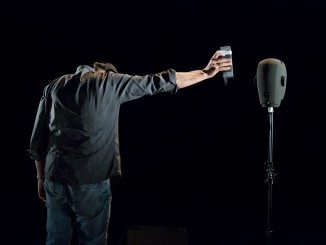
Before me, 19 performers dance to Reel 2 Real’s ‘I like to move it’. Some are dancers, some are actors, and some have never performed before. It’s not your standard dance choreography, and it is definitely not abstract. The song is being taken literally, each performer has a different ‘it’ that they like to move, and they sure move it! There are arms, shoulders, bums and other surprises. As the song continues, the actions get more manic. It’s quite unlike any dance piece I’ve seen before. It is one of the unexpectedly joyous numbers in Jerome Bel’s The Show Must Go On.

If you’ve noticed a drop off of the number of shows I’ve been able to go out and review on this blog, I do have a very good reason. I am the Show Must Go On’s ‘DJ’, the show’s glorified sound and lighting operator. Apparently they were looking for a professional techie, but because there is a super special dance solo involved, none were willing to put up their hands. So they’ve ended up with me. I’ll be sitting in front of the Mercury Theatre stage at a special desk doing the sound and lighting, and at one point, a little bit more.

The Show Must Go on was created by French Choreographer Jerome Bel and his original company 10 years ago. Since then, it has been performed around the world. In each city, a new local company made up of a mix of amateurs and professionals are taught and perform the show.

11Mar/110

REVIEW: The Manganiyar Seduction (Auckland Arts Festival)

Think inside the square [by Sharu Delilkan]

The Manganiyar Seduction

Indian Celebrity Squares!

In the bar prior to the performance someone said “Are you ready for ‘Indian Celebrity Squares’?”. And that was exactly the structure of the musicians we were greeted with onstage, with nine musicians across by four storeys high, revealing a whole grid of musicians who were eventually collectively lit.

This was the beginning of The Manganiyar Seduction experience.

The visual was a little bit puzzling although we all knew that we were there to witness something that most of us had never seen before.

So with an open mind, I decided to let the evening unfold.

9Mar/110

REVIEW: Smoke & Mirrors (Auckland Arts Festival)

Camp Circus Freaks [by James Wenley]

Smoke & Mirrors

Smoke & Mirrors, a winning combination.

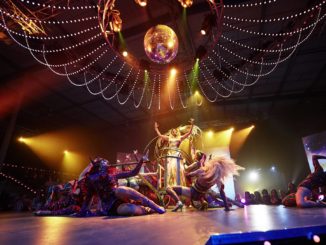
With this show especially, there is a reason why the performers are on the stage, and we can sit in the audience of the very attractive Spiegeltent. Many of the acts needed strength and ability that only years of training can bring. Nor would most of us, I suspect, be willing to display the performers’ sheer unbridled sexuality in a public setting. The Smoke & Mirrors performers enchant and amaze us, and we’re glad we can watch.

Smoke and mirrors of course, are the age old theatrical tricks used to astound the audience and ‘trick’ them about what they are seeing. The show in fact isn’t really anything new, but contains elements of circus, cabaret and magic. What makes the show special is the presentation – sexy,dark and sophisticated. It’s the naughty cousin of Cirque Du Soliel.

9Mar/110

REVIEW: Vietnamese Water Puppets (Auckland Arts Festival)

Puppets, on water, from Vietnam  [by James Wenley]

Vietnamese Water Puppets

Are puppets taking over Auckland?

The Festival Garden in Aotea Square contains quite a treat. At the back, a small lake has been created. Regularly during the festival the Thang Long Troupe of Hanoi perform water puppetry there. You should seek it out.

Water Puppetry is an art form that has been going strong for 1000 years. It was very much a part of cultural life with performances marking and celebrating the end of rice harvest, religious festivals, and other important occasions, and made use of the ‘paddy fields, rivers, canals, lakes and ponds’ of the Northern delta.

It was raining the evening I attended, but that doesn’t stop anyone. The festival organisers have the foresight to hand each audience member a plastic rain-honcho to wear. I’m not sure what would have been the stranger sight that day – puppets seemingly moving through the water by themselves, or rows of people wearing the same ridiculous outfit!

Before the puppetry a band of five entertain us with traditional Vietnamese music, as well as a nice nod to a famous kiwi song. The music is lively, and I enjoy the exotic sound.  The singer Vu Thi Loan has a wonderful voice and is quite strikingly beautiful in her traditional outfit; she takes her time to look out to each audience member, and the many children in attendance.

8Mar/112

REVIEW: Havoc in the Garden (Auckland Arts Festival)

Havoc on the Stage! [by James Wenley]

Havoc in the Garden

Havoc in the Garden

From the outside looking in, our lives must seem bizarre, rushed, and incomprehensible. Havoc in the Garden cuts open houses and allows us to peek into other people’s lives. A brilliant scene shows people living their lives in parallel, unaware of each other, all talking and behaving in their own little bubbles. It’s chaotic and fascinating. At other times the play necessarily blocks out the rest of the noise, focusing in on different family groups and their lives and dramas. Out of this intense focus, emerges some sort of meaning and insight into the human condition. And it’s not pretty. That’s damn good theatre.

Sean Coyle’s set is some achievement, squashing a  number of living spaces from different houses on the ‘hills’ onto the smallish Herald Theatre stage (the show is travelling to and ), and the play follows a number of different characters and storylines. What connects all the characters is an event that shatters their neighborhood – a woman screaming, a series of gunshots, and the order by the police to stay in their houses.

7Mar/111

REVIEW: Paper Sky – A Love Story (Auckland Arts Festival)

Paper and Puppetry.

Paper Sky

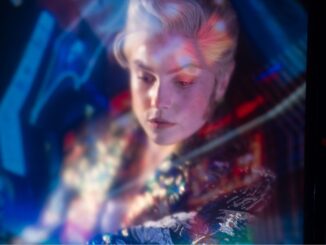
Julia Croft and Emmett Skilton in Paper Sky. It’s not every day you fall in love with a paper puppet..

Sometimes theatre can take you to that other place. All the elements combine to transport you to the place akin to the dreamland, the subconscious, where anything can happen. I’ve had this experience before, in Red Leap Theatre’s previous work The Arrival no less. It was with high hopes that I entered the Glen Eden Playhouse for this year’s Auckland Arts Festival offering Paper Sky – A love story, and white it came tantalisingly close to a sort of transcendence, not all elements were in harmony.

It’s an obvious one, but I’ll go there: The plot of Paper Sky is paper thin. Emmet Skilton (who is seen regularly in his undies in The Almighty Johnsons) plays Henry, an author who has trapped himself in his house and fears the outside world and all its noise. He is writing a story about a world made of paper and a heroine called Lumina, bought to life as a puppet by Julia Croft. Reality and fiction blur as she and the story enter his world. Henry gets caught in the action too, becoming a puppet, and leaves his ordered everyday life to go on an imaginatively expansive and dangerous adventure. Artistic Directors Kate Parker and Julie Nolan use this simple storyline to treat us to a host of amazing theatrical sights and delights.

Paper Sky is a world that is constantly moving, the set always transforming before our eyes. It is a world where giant reindeer walk, and mountains with a rickety bridge can appear out of nowhere. The design work is breathtaking. John Verytt’s folding set gets top marks, and I love the blue toned colour scheme, aided by the ever dependable Elizabeth Whiting’s expressive costumes and Jeremy Fern’s excellent lighting design. Kate Parker receives an unusual credit for ‘Imagery design’, but with the imagery being the strongest element of Paper Sky, it is well deserved. The show’s aesthetic is wonderful really, and much of what is used onstage is made out of paper (emphasising ideas of fragility). The program reveals that the paper is specially harvested and made by ‘paper artist’ Mark Lander, and Veryt’s set is constructed out of engineered recycled card. Marvelous.

The sound design (Andrew McMillan) adds so much to the show too, the score itself sounding particularly magical and fantastic. Before the show we get into a suitable mood with a soundtrack of timeless love croons.

Emmet Skilton’s uptight Henry is mute for the most of the show, and he does excellent work conveying his feelings and fears with much subtlety. He is helped by a trio of comic characters (Veronica Brady, Alison Bruce and Justin Haiu) who follow him around, pour him tea, wipe his mouth, and seem to represent different parts of his psyche (his id?). These three are wonderfully expressive and quirky, and they also do a great job of manipulating other puppets and design elements through the show. Julia Croft is mainly tasked with bringing the Lumina puppet to life, a sort of skinnier paper rag doll. The main point of articulation is a stick at the back of the puppets head which wasn’t always moved with precision; sometimes the head would drop and the puppet would ‘die’ and I’d be pulled out of the world.  

My main quibble is story. I don’t feel stories always have to be complex – simple is good – but I felt that it was the imagery that drove the story, rather than the story driving the images. The play is subtitled ‘A love story’ (Julie and Kate wanted to explore the idea of ‘impossible love’.), but I felt this love story was entirely arbitrary. I didn’t get any insight as to why Henry falls in love with Lumina, other than the fact he created her, or what Henry is to Lumina. The created dangers faced in the paper world took precedence. There are themes and ideas that that could do with more teasing out.

The show works hard, but I could never get entirely swept away. There is much to love though and many moments of awe and beauty. Read Leap continues to do excellent original imaginative work, quite unlike anybody else.

Paper Sky – A Love Story plays as part of the Auckland Arts Festival. The Glen Eden Playhouse season has finished, but will play at the Mercury Theatre from the 10th-14th March.

More information at the Auckland Arts Festival website.