REVIEW: King Lear (Summer Shakespeare)
Game of Thrones [by James Wenley]
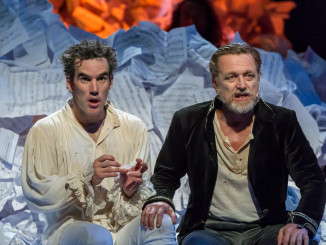
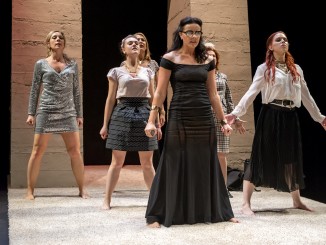
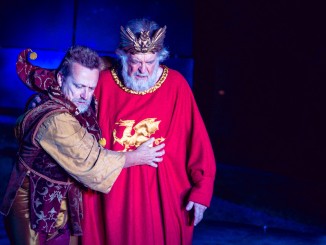
When I consider King Lear I think of the high grand tragedy, the demands of the title role and the master actors who have played him, and I conjure the harrowing image of the old man against the storm on the heath. It was pleasing to be reminded that the play begins (where it all begins really) with humorous sexual bawdy concerning the mother of Gloucester’s bastard son Edmund – “good sport at his making” - rather than anything loftier. The action of this production of King Lear plays out on a large circular stage by designer Jessika Verryt – an image of a flat earth that at any moment they could teter off. It is a fitting image for a play that contains the gamut of human experience: family feuds; wisdom and madness, power and greed; compassion and the worst inhumanity and violence mankind is capable of. The mix of themes high and low and the damning portrait of humankind is the best stuff of Mr. William Shakespeare. But what truly elevates Lear specifically from others in his canon is its focus on our weakness and mortality. Death not by the swift sword, but - to borrow the sentiment of another Shakespeare tragedian - death by a thousand natural cuts. Verryt’s stage also becomes the wheel of time that will catch all in the end be they Kings, Popes, academics: the tragedy of the aging; decay of the body and the mind.
At the far side of outdoor lawn at the Old Arts Quad are images of great beauty: the heavens, the cosmos. Behind them are shining lampposts that dot the paths behind the set that by happy accident seem extend out and back, enlarging the vista. Brad Gledhill’s lighting complements the disappearing light of the out in the open evening. We are situated amongst this all too: tiered seating on two sides is like a sheer cliff, and we look down at the players from above. Edmund speaks of the folly of blaming and crying out to the heavens as if “if we were villains by necessity; fools by heavenly compulsion”. In Director Lisa Harrow’s production her figures are all too earth bound, focussed on themselves and their own quest for power, cut off from anything higher or worthier. Making her directorial debut, Harrow presents a production that is grounded, uncluttered, and where the text is King.
REVIEW: Tribes (Silo)
Now how to express my experience? [by James Wenley]
Tribes comes to Auckland’s stage with a babble of hype and expectation. Only playwright Nina Raine’s second play (after Rabbit which Silo performed in 2008 ), it’s something of an international critical darling after its debut at London’s Royal Court in 2010. Just last week it won New York Drama Desk’s Outstanding play award. So no question it would be good then, but just how much. Answer? Very good indeed.
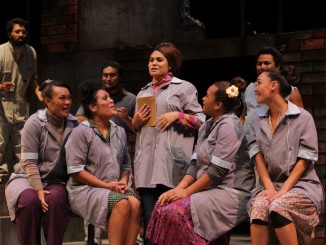
One of the titular tribes in the play are a family (unencumbered by surname) an internally-warring yet deeply self-protective family made up of Dad Christopher (Michael Hurst), Mother Beth (Catherine Wilken), boomerang twenty-something kids Daniel (Emmett Skilton) and Ruth (Fern Sutherland), and youngest Billy (Leon Wadham) who, while being careful not define him as such, is deaf. The family have proudly bought him up in a ‘speaking’ environment, getting by with hearing aids and lip reading (a painfully slow learning process, credit to Mum).
This family’s default mode of communication, summed up by Christopher is: “Join in, have an argument”. Tribes launches us into a noisy family dinner; everyone speaking over the top of each other, getting their two cents in. It’s a revealing mixture of affection, annoyance and mocking that close familiarity breeds, and a very recognisable family dynamic indeed. But everyone? Billy, watching, processing, becomes my figure of attention, for the family are all but ignoring him. He says little, save for an odd “What are you talking about?”.
PREVIEW: Tribes (Silo)
Rejoining the tribe [by Sharu Delilkan]
Although it has been almost four years since her Silo debut, Fern Sutherland still remembers the experience as if it were yesterday.
"It was my first gig out of [UNITEC] drama school and I was extremely nervous when I met Shane [Bosher]. I felt very insecure and was desperate to make a good impression," she admits.
That's when she played an old woman in Life is a Dream working with Bosher, who's directing Silo's latest show Tribes.
However in Tribes, playing Ruth the middle child of a bohemian, intellectual upper-middle-class British family, the 24-year-old Sutherland says she feels slightly more at ease and able to enjoy the process.
REVIEW: The Waste Land (ATC Participate)
April is the cruelest month... [by James Wenley]
Last week I was fortunate enough to experience a profound theatrical event. It’s been a few days now – most productions wash off soon after viewing – but in this one I keep returning to its moment in my head.
I find experiences like these are all too rare, but it’s what keeps me coming back to theatre; the promise of being taken out of my body, to be transported to an undiscovered territory, to feel something new. And when that promise is realised, it’s a special thing indeed.
T.S Eliot’s 1922, 432-line poem The Waste Land is considered one of the most important works of literature of the 20th Century. I don’t claim to understand it. It’s a work that rewards the academic, full of allusions and depths to unravel. It flicks from image to image, voice to voice.
But as a poem, it contains its own sort of dark power. Certain words and phrases linger on the tongue. There’s an obsession with mortality and death. It’s a poem that means many different things to many different people, but within its words, you might just find the totality of existence.
The poem is given a startling voice and vitality in a theatrical interpretation by director Michael Hurst, the first production in Auckland Theatre Company’s Participate program. What immediately distinguishes the production is Hurst is working with a company of 34 actors, an immense number that professional stages costs hardly allow. What then makes the production exceptional is that this company of 34 are all aged 65 years old and over. Some were alive before The Waste Land had even been written. It’s an age group that is rarely given a voice and platform in the professional arts, and certainly never in these sorts of numbers.
REVIEW: RED (Auckland Theatre Company)
"What do you see?" [by James Wenley]
I’ve started with a quote. "What do you see?"
It’s the first line of RED by John Logan (he of Gladiator and The Aviator fame) , presented by the prestigious Auckland Theatre Company, starring theatre luminary Michael Hurst and directed by Mr. Oliver Driver. Sterling credentials all.
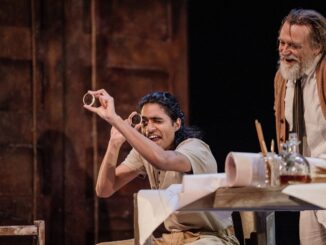
“What do you see?” says Hurst as Mark Rothko, to prospective assistant Ken (Elliot Christiensen-Yule), about one of his paintings. Ah, Art and the subjective position. While one person might see meaning and a parade of emotion, another might see just see the colour red. The Rothko works at the centre of this play are red - big canvases of colour with subtle shading. In a dazzling theatrical set piece, Yule and Hurst madly paint a canvas in front of our eyes with big brush strokes.
What do I see when I look at this production? There is Red, but also a great deal more.
Rothko was an American painter who emerged as part of the Abstract Expressionism movement in the mid 20th Century. His style changed over his career, but he is best known for his ‘mature style’ – (to quote Linda Tyler’s excellent essay in the program) “abstractions with floating blocks of pure colour which lifted viewers away from the sights and sounds of modern life into a meditative space”. Rothko died a suitably tragic artists death (which is brilliantly foreshadowed within the play) of “slashing the veins inside the crooks of his own arms”.