Theatre Scenes: Auckland Theatre Blog (Reviews, interviews and commentary)
14Dec/110

REVIEW: Silent Night

Spend the Night with Irene [by James Wenley]

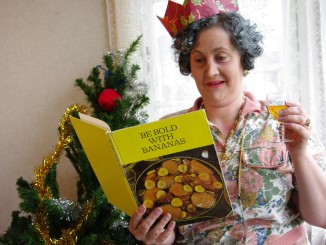
"Be bold with Bananas" - An essential book for Xmas lunch inspiration

Irene McMunn’s Christmas cheer has been charming audiences in small venues across the country.

So much so, that director Stephen Papps has lost track of how many seasons the one woman show has had. This return season at TAPAC is the first time he’s seen the show since March. Impressively, it’s the third Auckland season after its debut at the Musgrove Theatre this time last year, a testament to its audience appeal, and the performance of actor/playwright Yvette Parsons.

The Christmas themed Silent Night has played both during ‘on’ and ‘off’ seasons, and while its strength of character and message is relevant at all times, I suspect at this time of the year it gains its extra poignancy.

TAPAC has been decked out with cabaret style tables and seating. The touring set, a homely interior, is raised high on rostra for audience visibility. Pink, in all its shades, is the overwhelming colour in this unit; the couch, floral wall paper and Irene’s dress are awash in it. As a space it tells much that we’ll need to know about the character, full of individual touches and flourishes, from the displays of Prince Charles and Diana wedding memorabilia, to the beautiful doll sitting on the couch.

The first we hear of Irene is her booming voice as she belts out her own unique version of the perennial Silent Night. It’s an instant charmer, her trait of bursting into carols welcome interludes throughout the show, and later touching expression of emotion. She appears onstage, and begins to chat away at us. We are warmly eased into her world as she freely espouses on different topics as they occur to her, flitting from one train of thought to another. The Chrisco’s hamper has newly arrived, and she takes us through an inventory (“That’s a good brand”). It’s Christmas day, and she’s waiting for her guests to arrive for a tea party.

14Nov/111

REVIEW: The Bone Feeder

Feeding the Past [by James Wenley]

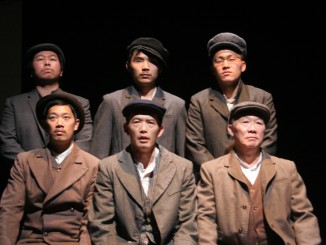
Chinese Miners came to New Zealand in the 1800s

I first encountered playwright Renee Liang’s The Bone Feeder in 2009, presented as part of her postgraduate diploma of Arts at the University of Auckland, which I reviewed for Craccum Magazine.

Since then, Renee (known also for plays Lantern & The First Asian AB) has continued to develop and work on the play. More productions followed, and now it makes it’s fully fledged professional debut at TAPAC directed by Lauren Jackson, with a cast of ten, 4 live musicians, and even martial arts wire work.

The initial season of The Bone Feeder was the first time I had been exposed to a little known tragedy in early Chinese history in New Zealand, which has ongoing echoes today. The Gold Rush saw a wave of Chinese migration to New Zealand, many working to send back money to their families at home. Liang says they considered themselves “temporary visitors”, hoping to return one day. Many didn’t, and the remains of 499 deceased Chinese miners were to return home to China in 1902 on the SS Ventor. The miners however were never able to be reunited with their families, the Ventor sinking in the Hokianga Harbour.

8Sep/110

REVIEW: Raising the Titanics at Q Theatre

Raising the Titanics, Raising a Theatre  [by James Wenley]

Raising the Titanics

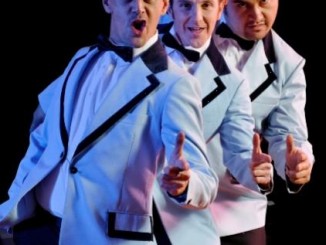
The Raising the Titanics Men

The Maori Volcanics show band in their 60s heyday were arguably our most famous exports. With members included bonafide legends Prince Tui Teka and Billy T James, they took their unique mix of song, comedy, and Maori culture around the world to the USA, Vietnam, Israel, Europe, playing to royalty and appearing on the same bill as other bonafide legends like Sammy Davis Jr.

The Titanics are a band like the Volcanics, though they never existed. Playwright Albert Belz and Producer Tainui Tukiwaho (who coincidentally recently graced our small screen playing Billy T James himself) initially explored doing a play involving the likes of Howard Morrison, Tui Teka and James before going with the story of a fictionalised showband. It’s a clever idea, able to honour the legends without being restricted by biographical details, and to pay tribute to an essential piece of kiwi music history.

It’s a history I fully admit to being quite ignorant of, and by paying homage to the showband culture Raising the Titanics succeeds the most. For those like me, here’s a clip of Billy T James and Prince Tui Teka performing with the Maori Volcanics… enjoy.

5May/111

REVIEW: Gavin puts things straight

Clear eye for the straight guy [by Sharu Delilkan] 

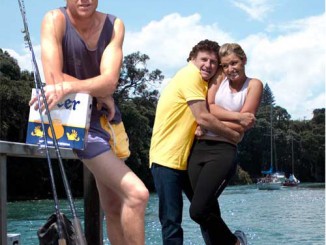
Gavin puts things straight

Gavin puts things straight

It’s not often that North Shore residents get the opportunity to see a play that offers an eccentric and a somewhat exaggerated reflection of themselves. 

 But being a Shoresider himself playwright Andy Saker provides the perfect perspective that at times makes the audience cringe due to the harsh reality of the situations he’s created in his skilfully scripted play Gavin Puts Things Straight

 The sequel to Pear Shaped, the play is centred around a typical North Shore family living what appears like a simple existence on the ‘sunny’ side of the bridge.  They are handyman Gavin (Pete Coates), his mum Noelene (Louise Wallace), who's shacked up with young ‘stud’ Duane (Allan Roberts), his dad Keith (David Mackie), younger brother James (Daniel Bonner) and grandad (Michael Murphy). 

 The play is very much in keeping with the spirit of Pear Shaped.   Domestic situations of the living room, workplace and an old people’s home provide familiar settings to the mostly North Shore audience. 

 Comic references to Milford, Takapuna, South Africans (loud arrogant and with no dress sense) also lend the play a local flavour – rare in Auckland theatre. 

8Mar/112

REVIEW: Havoc in the Garden (Auckland Arts Festival)

Havoc on the Stage! [by James Wenley]

Havoc in the Garden

Havoc in the Garden

From the outside looking in, our lives must seem bizarre, rushed, and incomprehensible. Havoc in the Garden cuts open houses and allows us to peek into other people’s lives. A brilliant scene shows people living their lives in parallel, unaware of each other, all talking and behaving in their own little bubbles. It’s chaotic and fascinating. At other times the play necessarily blocks out the rest of the noise, focusing in on different family groups and their lives and dramas. Out of this intense focus, emerges some sort of meaning and insight into the human condition. And it’s not pretty. That’s damn good theatre.

Sean Coyle’s set is some achievement, squashing a  number of living spaces from different houses on the ‘hills’ onto the smallish Herald Theatre stage (the show is travelling to and ), and the play follows a number of different characters and storylines. What connects all the characters is an event that shatters their neighborhood – a woman screaming, a series of gunshots, and the order by the police to stay in their houses.

7Mar/111

REVIEW: Paper Sky – A Love Story (Auckland Arts Festival)

Paper and Puppetry.

Paper Sky

Julia Croft and Emmett Skilton in Paper Sky. It’s not every day you fall in love with a paper puppet..

Sometimes theatre can take you to that other place. All the elements combine to transport you to the place akin to the dreamland, the subconscious, where anything can happen. I’ve had this experience before, in Red Leap Theatre’s previous work The Arrival no less. It was with high hopes that I entered the Glen Eden Playhouse for this year’s Auckland Arts Festival offering Paper Sky – A love story, and white it came tantalisingly close to a sort of transcendence, not all elements were in harmony.

It’s an obvious one, but I’ll go there: The plot of Paper Sky is paper thin. Emmet Skilton (who is seen regularly in his undies in The Almighty Johnsons) plays Henry, an author who has trapped himself in his house and fears the outside world and all its noise. He is writing a story about a world made of paper and a heroine called Lumina, bought to life as a puppet by Julia Croft. Reality and fiction blur as she and the story enter his world. Henry gets caught in the action too, becoming a puppet, and leaves his ordered everyday life to go on an imaginatively expansive and dangerous adventure. Artistic Directors Kate Parker and Julie Nolan use this simple storyline to treat us to a host of amazing theatrical sights and delights.

Paper Sky is a world that is constantly moving, the set always transforming before our eyes. It is a world where giant reindeer walk, and mountains with a rickety bridge can appear out of nowhere. The design work is breathtaking. John Verytt’s folding set gets top marks, and I love the blue toned colour scheme, aided by the ever dependable Elizabeth Whiting’s expressive costumes and Jeremy Fern’s excellent lighting design. Kate Parker receives an unusual credit for ‘Imagery design’, but with the imagery being the strongest element of Paper Sky, it is well deserved. The show’s aesthetic is wonderful really, and much of what is used onstage is made out of paper (emphasising ideas of fragility). The program reveals that the paper is specially harvested and made by ‘paper artist’ Mark Lander, and Veryt’s set is constructed out of engineered recycled card. Marvelous.

The sound design (Andrew McMillan) adds so much to the show too, the score itself sounding particularly magical and fantastic. Before the show we get into a suitable mood with a soundtrack of timeless love croons.

Emmet Skilton’s uptight Henry is mute for the most of the show, and he does excellent work conveying his feelings and fears with much subtlety. He is helped by a trio of comic characters (Veronica Brady, Alison Bruce and Justin Haiu) who follow him around, pour him tea, wipe his mouth, and seem to represent different parts of his psyche (his id?). These three are wonderfully expressive and quirky, and they also do a great job of manipulating other puppets and design elements through the show. Julia Croft is mainly tasked with bringing the Lumina puppet to life, a sort of skinnier paper rag doll. The main point of articulation is a stick at the back of the puppets head which wasn’t always moved with precision; sometimes the head would drop and the puppet would ‘die’ and I’d be pulled out of the world.  

My main quibble is story. I don’t feel stories always have to be complex – simple is good – but I felt that it was the imagery that drove the story, rather than the story driving the images. The play is subtitled ‘A love story’ (Julie and Kate wanted to explore the idea of ‘impossible love’.), but I felt this love story was entirely arbitrary. I didn’t get any insight as to why Henry falls in love with Lumina, other than the fact he created her, or what Henry is to Lumina. The created dangers faced in the paper world took precedence. There are themes and ideas that that could do with more teasing out.

The show works hard, but I could never get entirely swept away. There is much to love though and many moments of awe and beauty. Read Leap continues to do excellent original imaginative work, quite unlike anybody else.

Paper Sky – A Love Story plays as part of the Auckland Arts Festival. The Glen Eden Playhouse season has finished, but will play at the Mercury Theatre from the 10th-14th March.

More information at the Auckland Arts Festival website.

3Mar/110

REVIEW: Chalk (Auckland Fringe)

Anywhere but Shady Meadows! 

Chalk

Chalk it up.

There is something very disconcerting watching Isla Adamson and Josephine Stewart -Tewhiu  play elderly characters in their devised Fringe play Chalk. These gorgeous young performers transform and contract their bodies in such a believable way that the characters have a sense of the uncanny.

Welcome to Shady Meadows Retirement home. A commercial voice over tells us all the great activities and facilities the home has, and how they encourage their residents to reach their “human potential”…  meanwhile two of the elderly residents sit firmly chair bound with little to do. Isla and Josephine play multiple characters including the elderly residents, the workers, and younger visitors.

They switch between these characters with ease, aided by Abigail Greenwood’s direction. The audience favourite is Nina, a proud Maori grandmother with a warm humour, who packs her bags every day, convinced that her family is going to come and get her. She shares her scenes with Josephine’s Alice - her grandmother, who wants only to see her elder grand-daughter and not Alice, has dementia (painfully moving). Nina and Alice strike up an unlikely friendship and help each other deal with life and absent families. Isla and Josephine produce performances that are full of humour, heart, and integrity.

Unlike their previous work Ruby Tuesday, which was a huge hit for the inaugural Fringe festival, this piece isn’t as continuously laugh out loud funny. This is no criticism, for this work deals with some pretty deeply felt universal fears: aging, abandonment, losing your sense of self. Most of the humour arrives organically from the character’s personalities and their situation, the ‘overtly’ funny and shallower characters like Shady Meadows workers Clint (Isla) and the immature Karen (Josephine) are less successful, though they have their moments. I feel there is more material to be explored with the  workers, particularly how dealing with elderly and frequent death affects their emotional lives. The announcement towards the end of the play poignantly farewells one of the residents that died that day, but cheerfully welcomes the next person who is moving into the vacated rooms the following day.

The elderly frequently ask how their families could have left them there. Retirement living is a fraught debate, and Isla and Josephine pull it off with deep sensitivity.  At my more tender age, it certainly bought up stuff for me that I know is inevitable, but don’t actively engage and think about. In this respect, the play absolutely succeeds; exploring these big issues in a gentle way without trivialisng them.

I enjoyed spending time at the Shady Meadows Retirement home and with these characters. Chalk is a deeply felt play that leaves me both hopeful about the aging process, and also thoroughly terrified!

Chalk plays as part of the Auckland Fringe Festival at the Basement Theatre until 6th March.

More information at the Auckland Fringe Website.

26Feb/110

REVIEW: Joseph and Mahina (Auckland Fringe)

Romeo & Juliet. Antony & Cleopatra.... Joseph & Mahina?

Joseph and Mahina

Check out those expressions!

I’ve written about Thomas Sainsbury plays many times before in Craccum Magazine. He’s something of a modern kiwi Shakespeare type, dominating Auckland over the last several years with a huge output of low budget but manically funny. Like Shakespeare he sometimes acts in his plays too and he directs most of them too. He even now has made his mark on television with Supercity, co-written with Madeline Sami, which I reckon is the first really great scripted NZ comedy show for a long time. Hoorah.

So I always know that I’m going to have fun night when I see a Thomas Sainsbury Show™. In Joseph and Mahina the direction is taken by Hera Dunleavy in her debut, allowing Sainsbury to act alongside Renee Lyons, one of his regular players. It is set in a small rural town in NZ; Sainsbury says it was inspired by growing up in Matamata. In an interesting echo to I won’t be happy until I lose one of limbs which played earlier this month in the Basement and also set in a small town, there’s a real desperation shared by its characters and yearning to leave. Joseph has just arrived, a married 28-year-old Christian, come to lead the church’s Youth Group. Hardly anyone bothers to show. His only regular is 17-year-old high school drop out and supermarket worker Mahina; her family are on the dole and don’t really care about her.

Between them, Tom and Renee play 11 different characters through the show. There’s the disgruntled supermarket supervisor Shane who was made redundant, a town gossip Hillary (Sainsbury camping it up just the right notch), Joseph’s quiet wife, the doddery Reverend (Lyons).... The actors work off each other energies superbly, and their characterisations are all very distinct. Renee in particular plays Mahina truthfully and with simplicity, and the comedy naturally arrives. Tom impresses with his coming timing and character flairs, and works best playing the broader characters, though Joseph has dramatic moments to shine. Sainsbury is such an exact character writer, with particular skill for idiom and character speech and as usual there are many scriptural gems.

 Like many of his other shows, Joseph and Mahina embraces the low budget restrictions: there is little set to speak of and simple props and costumes to identify the characters. There is no need to dress up the space; the focus is firmly on the story, and the wicked characterisations from the actors. I did feel that the play lost momentum each time a scene would end when the actors paused, lights dimmed, and changed character.

When I interviewed Tom in mid 2009 (not online, sadly), he agreed he had a style “Yes I would say theres a Tom Sainsbury style, even though I’ve tried to get away from the style, but it seems I keep going back into it. It seems to be comedic, there have to be high tragic stakes for each of the characters, death and rape and suicide regularly feature. Ludicrous characterisation and black humour.”  Since then, he has been exploring more genres (I loved Psychopaths, a slasher play!) and danced with Jacqui Brown (Dance Troupe Supreme) among others. This new play I feel marks a growing maturity, very much within his style, but with a deeper heart and soul.

Joseph and Mahina, as the title suggests, fall in love. It’s wrong, funny, a train wreck... but it’s beautiful to watch. You believe and care for these characters. Under the comedic surface of the play there are some deeper issues – the town has been rocked by redundancies, and there is no future for the young like Mahina. What does this do to people? The supermarket supervisor Shane is the designated villain of the piece, but we know his redundancy from the meat works is demoralising, and Sainsbury cleverly gives us more insight into what could have been a one note character by showing us his wife as the town flirt, hooking up with random guys at the bar right in front of his nose. No wonder he is bitter about life.

It loses its way slightly at the end, and I felt it ignored a natural conclusion and kept going one too many scenes to many, leaving us with an ambiguous ending.

I enjoyed spending time with these characters - Renee and Tom deliver superbly. Joseph and Mahina is a welcome addition to the Sainsbury play canon. May the Bard of Matamata continue to dominate. I’m still holding out for your Hamlet Tom!

 Joseph and Mahina plays as part of the Auckland Fringe Festival at the Basement Theatre until 28th February

More information on the Auckland Fringe website.

26Feb/110

REVIEW: Feel Felt Found (Auckland Fringe)

I found this play to be funny

Feel Felt Found

Nic Sampson, Ryan Richards and Barnaby Fedric suit up well

Pity the struggling actor. In order to support themselves when work runs dry, they must take a serious of unholy jobs until the day Peter Jackson rings out of the blue with a film offer. The ‘comic triumvirate’ behind Feel Felt Found – Ryan Richards, Nic Sampson and Barnaby Fedric must have experienced something along these lines. “Inspired by the time spent dabbling in telemarketing” they write in the program, this fast-paced comic morality tale displays an apathy towards the ethics of big business and selling things people don’t want or need.

‘Feel Felt Found’ is a marketing concept that can be used to sell anything. The business in Feel Felt Found uses it to sell the David McEwan investment report (the show’s sponsor, as it turns out, and a report you can get for free!). It goes something like: “It’s interesting you feel that way... a lot of people have felt that way... but what they have found is completely opposite”. Ryan Richards plays the affable lead that is drawn into the world of selling and sells his soul to the devil in order to succeed (or at least, give the devil a lingering pash!).

Nic Sampson and Barnaby Fedric play a host of supporting roles. They play brilliantly off each other as the two Garrys - two people called Garry at the office whose bravura don’t match their actions. Sampson’s megalomaniac boss is a great creation.

There is a mad energy through the show, and they exploit their scenario for all its worth, filling it in with as many sketches imaginable in this type of workplace. The story arc is predictable, but what happens through it isn’t, with many unexpected comic moments, and one of the more creative death scenes I’ve seen. There is a juvenile South Park type sensibility, falling back on easy laughs from wees and poos joke, which their witty script shows they don’t need.

It’s all surface sure, and doesn’t leave me much to think about afterwards. But in the moment its funny, the cast are super talented and watchable, and if there is any justice, shouldn’t have to go back to telemarketing.

Feel Felt Found plays as part of the Auckland Fringe Festival at the Basement Theatre until the 1st March.

More information on the Auckland Fringe Website.

23Feb/110

FRINGE PREVIEW: The ‘Motherlock’ Controversy

Lock up your Mother!

Motherlock by Melissa Fergusson

The Motherlock controversy started fairly early...

If it was a competition, Motherlock would be odds on favorite to win the not always coveted ‘Most Controversial Play Award’ in this year’s Fringe circuit. Unashamedly based on the real life experiences of Auckland playwright and director Melissa Fergusson, it explores the stigmas and experiences of her four pregnancies to four different men. Scandalous? You bet.

Playwrights traditionally hide behind metaphor and obfuscate about how much of their work is based on real life. By presenting herself, warts-and-all, Melissa has very much opened herself up to criticism - not just about the play, but about her own life choices. She says audience feedback has been positive, but the play has been given a heavy critical lashing -  “a story told with no purpose and it therefore has no value” writes Theatreview’s John Smythe. Ouch.

Why did Melissa did chose to present her own life? And what does she make of the heavy criticism? I found out.

We live in a confessional culture. Reality TV and Facebook and Twitter updates encourage it... Playwrights are often inspired by their real lives, but it strikes me as still relatively rare for a playwright to openly write about their own lives. Why did you?

I started speaking to a friend about 18 months ago about the children, and they said wouldn’t it be great to write something for the children so they knew a whole lot more about how they came about, and their fathers. It grew from there; it became a draft and went on and on. I met Donna Banicevich Gera and she became my advisor, and she had a lot of encouragement and it grew into a 60 minute monologue.

Why make it non-fiction then, rather than fiction?

I was attracted to writing something that was close to my life, and I just wrote it. I just thought that the content of the play was interesting and that’s why I wrote about it. I didn’t really question myself an awful lot when I wrote it.

And you see the work as being very experimental?

Very controversial in the sense that its dealing with issues, lots of different themes…. mothering a child without a partner, the rapid decisions a woman has to make when they are in a relationship that is breaking down. It’s quite unpredictable as the mother goes along what her next challenge is, and I believe there is a lot of positivity and good outcomes that come about with Motherlock.