REVIEW: Eigengrau (potent pause) productions
More than black and white [by Matt Baker]
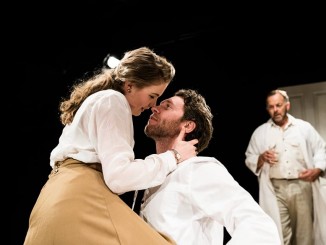
Meet Cassie. She’s just moved in with Rose, who’s just had a one-night stand with Mark, who's fed up of living with Tim, who secretly loves Rose, who’s just using Tim to get to Mark (who she loves), who’s just become very interested in Cassie. While the magnitude of that sentence is slightly complex to envision with great clarity, this production of Penelope Skinner’s Eigengrau is anything but grey. Though (potent pause) Productions is a somewhat obscure company - 13 productions in 11 years, with a slight emphasis on the works of Pinter and a bit of Mamet and Ionesco thrown in for good measure - it seems this company has a knack for not only stellar casts who make the most of poignant pieces, but also taking their time and developing a commendable and solid body of work.
Skinner has been called “our leading young feminist writer” by The Independent’s Nione Meakin, yet I would argue the word feminist spoils, and could quite easily be omitted from, that statement. While Cassie’s feminist dialogue is heavily loaded in comparison to Mark’s in regards to real estate, or Tim’s in regards to loss, or Rose’s in regards to numerology, it still feels more of a character trait than an underlying tone or message that the writer is trying to press upon her work, and Chelsea McEwan-Millar’s performance as Cassie certainly loads her journey with a much more connectable pathos for the audience than feminism alone would.
Calum Gittins’ Mark is cocky, smarmy, and utterly charming – and the audience loves to hate him. Not only does he imbue his character with these traits sincerely (in great contrast to the actual character) and in a way that parallels the playwright’s intentions, Gittins finds multiple layers on which to play and allows the audience to see exactly what is going on inside with a subtlety that eludes the characters around him. It is the perfect example of both the dichotomy and amalgamation between actor and character.
REVIEW: The Pitmen Painters – (potent pause) Productions
Billy Elliot meets RED [by James Wenley]
With Billy Elliot, everyone remembers the feel good inspirational story of the boy who became a ballet star. In revisiting the film recently, I was struck by the gritty social background – of Thatcher’s England and the miners sacrificing everything with lengthy strike action. For Billy, dancing was a way of escaping a life already set out for him; of following his father underground.
In his play The Pitmen Painters, Elliot screen-writer Lee Hall returns to similar concerns. Based on a book by William Feaver, and a fascinating real-life story, Hall follows the Ashington Group miners through the 30s/40s, who, encouraged by their art tutor, turn to painting for the first time and become darlings of the art world. While Elliott’s rags to riches dancing feet is a populist story (and later turned into a West End / Broadway musical with music by Elton John) and the Pitmen’s story is a far more intellectual one (this is Theatre with a capital ‘T’), they share much in common: Mining, social upheaval and class warfare - exchanging pickets for paints. One miner with great promise, Oliver, is offered a weekly stipend, worth more than his mining pay, to be a full-time painter – a chance to escape the mines and have a “proper creative life”. In both, we see Hall dealing with passions, creativity, self-expression in an otherwise oppressive environment.
PREVIEW: The Pitmen Painters – (potent pause) Productions
A Tale of Two Gittins [by Sharu Delilkan]

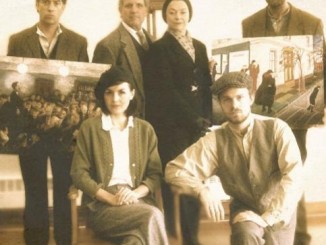
(Back L-R) John Glass, Edward Newborn, Elizabeth Hawthorne, Stephen Papps, Geoffrey Snell. (FRONT L-R) Josephine Stewart-Tewhiu, Calum Gittins.
Having worked on the international film circuit for the past few years, including The King’s Speech and The Lord of the Rings: The Two Towers, Calum Gittins jumped at the chance to work in theatre.
And when his dad Paul told him he was directing The Pitmen Painters it was a no brainer.
Paul [Gittins] says “I’ve always wanted an opportunity to work with Calum but he’s been overseas for quite a long time. So I was glad when I managed to persuade him to stay and be in the play.”
The Pitmen Painters, written by the Tony award-winning writer Lee Hall (Billy Elliot), is based on a true story of a group of English miners in Newcastle whose after-work art classes reveal a wealth of hidden artistic talent. Overnight, the amateur artists find themselves propelled from the humble mines of the North East to a rich, intellectual art world.
REVIEW: Finding Murdoch (Landmark Productions)
Murdoch Mystery de-Mystified [by Sharu Delilkan]
Having previously been to The Loft's inaugural show Venus Is, when the studio space was transformed into a raunchy bordello, it was a total contrast to be greeted by a sea of television screens on stage.
However the traditional tiered seating and set with newsroom desk and chairs, along with television camera and bookcase, as well as the aforementioned television screens, definitely help set the scene from the get-go.
As mentioned in a previous blog, I don't purport to be a rugby expert. And although I will openly confess that the Rugby World Cup fever has been all consuming, I have to admit that I am only recently acquainted with the iconic event surrounding the disappearance of the infamous Keith Murdoch.
For those like me who aren't familiar with the Murdoch story, his fame came out of All Black career ending controversially and mysteriously. He scored the All Blacks' only try in their 1972 win against Wales in Cardiff. However later the same night he was allegedly involved in a fracas which resulted in him being sent home from the tour by All Black management. Rather than returning to rugby in New Zealand, Murdoch virtually went into hiding, quitting his home and his sport and moving to the Australian outback where he has lived ever since.