Theatre Scenes: Auckland Theatre Blog (Reviews, interviews and commentary)
3May/130

REVIEW: Idiots of Ants Model Citizens (Comedy Festival)

Boys from Britain triumph again [by James Wenley]

If they are idiots, what does that make me?

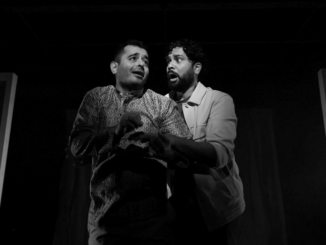
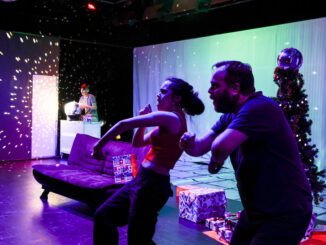
British sketch comedy quadrangle Idiots of Ants were my favourite acts in their Auckland debut at last year’s Comedy Festival. Amidst an amusement of stand-up comedians, Ants are a fresh and lively point of laughter-filled difference. Sketch as a form seems to be viewed as a bit antiquated today – it had its heyday in the Oxford/Cambridge humour of Monty Python, and the form has been noticeably absent in New Zealand since the days of Billy T James. What the members of Ants (Andrew Spiers, Elliott Tiney, Benjamin Wilson and James Wrighton.) do so well is take both a clever meta-ironic commentary on the form, but also wholeheartedly embrace the silliness of it all. And in Model Citizens especially it’s how they use us – their audience – that takes the show to a gleeful brilliance.

It doesn’t take them very long at all when the first sketch starts for the Idiots of Ants to turn to us and break the fourth wall – the loose premise of the show is that the boys live in a flat which just happens to have one very special feature: a live audience who think everything they do is funny and then mysteriously leave after an hour.  It’s just the start of many wonderful moments between the idiots onstage and the ants below, including the song ‘The man who took the audience to dinner’, which extends the idea of group dating to its logical extreme, and has the audience enthusiastically participate with powerpoint provided dialogue. It all culminated for this reviewer with a knock to the head with a stale bread roll flung into seating. This isn’t a show that pulls up red-faced audience members onstage, but the audience’s participation is an important part of the show. And the Ants lads charm us enough to make us want to too.

8Mar/130

REVIEW: The Factory (Auckland Arts Festival)

Pacific Side Story [by James Wenley]

The Factory Auckland Arts Festival

Our life started at The Factory!

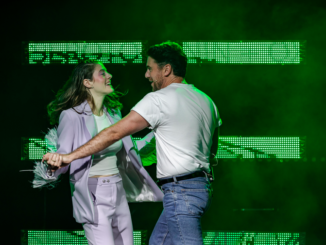
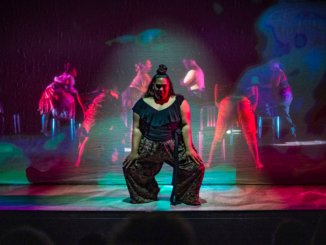
The chance taken on Kila Kokonut’s Krew The Factory - “New Zealand’s first Pacific Musical” - should prove the biggest statement of this year’s Auckland Arts Festival. Dedicated to the parents and grandparents of the creatives and cast who moved to New Zealand from the islands, The Factory began as a modest workshop production in 2010. A 4 week sell-out season of the Musical at Mangere Arts Centre was one of the theatrical highlights of 2011. While the joyous heart remains, The Factory has been completely transformed into a polished, slick, and assured musical theatre offering. The Factory is now West Side Story meets Saturday Night Fever with a Pasifika flavour.

Broadway Musicals famously go through years of workshops and try-outs to get main-stage ready, and the creators have embraced the opportunity to do something similar on a smaller scale. It really is a substantially different production to 2011: they’ve taken a wrecking ball and built it up again from its foundations. An analogy can be made considering the set designs. The original production used the wide expanse of Mangere, with three towers of scaffolding standing in for The Factory, the actor’s sketched in life and a catchy musicality that made for an entertaining skeleton that suffered from a difficult third-act. Now, like Sean Coyle’s grungy, chunky, factory floor set, this new production is concentrated, and tightly built, more concrete. The setting is transferred to the 1970s during the first wave of Pacific migration to New Zealand. The Polynesian boss is now a palagi, emphasisng racial and cultural tension, and the boss’s daughter is now a son, enabling a new romantic plot to become central to the drama. Favourites from the Musical score remain, but many are dropped: there are five new songs, and others have been retooled. Original directors Anapela Polataivoa, Vela Manusaute and composer Poulima Salima are joined by Tama Waipara as Musical Director and Composer, West End director Jonathan Alver as Creative Producer, and a mostly new cast.

22Feb/130

REVIEW: The Bitches Box (Auckland Fringe)

Hot Dog! [by Matt Baker]

The Bitches Box

The Bitches Box

After forty-two shows across the country in their (literal) Woolshed Tour, actresses Emma Newborn and Amelia Guild finally bring their two-woman show to Auckland for the 2013 Fringe Festival. “Born out of a dream and desire to provide rural audiences a chance to have a truly unique night out with their neighbours”, if the show was received as well on tour as it was on its opening night in the City of Sails, it could only have been an unreserved success.

10Jan/132

Looking Back: 2012 – A Theatrical year in Review

Taking the Risk [by James Wenley]

2012 belonged to George Henare

“…It was this lack of “weight” (a not too easily defined term which an actor, if not a member of the audience, would understand) that Mr George Henare needs to work on if he wishes to pursue the acting profession. His is a good, powerful voice, he has strong features… yet a lot of these advantages are dissipated by his unsureness in terms of movement, distribution of body-emphasis, and… style.” -   Review of Awatea

It would be a brave reviewer indeed who would dare to write such sacrilegious words about Mr George Henare today. That was George Webby, in 1968, in an across-the-board withering attack on the original stage production of Bruce Mason’s Awatea. For Auckland Theatre Company’s 2012 revival, Sharu Delikan called Henare’s acting “flawless” and “truly inspired”, with Henare coming full circle to play blind patriarch Werihe Paku, whose son Matt Henare performed as in 1968. 2012 was a year that in many ways belonged to Henare, with headline performances in Awatea, Peach Theatre Company’s Death of a Salesman, and Educating Rita for the new Newmarket Theatre Company. Henare stocked up on the actor carbs to deliver three weighty performances indeed, along with a lightness of touch and twinkle in the eye, it was breathtaking to see Henare at work.

As I embarked this year on a Masters project looking at forgotten ‘landmark’ New Zealand plays from the 40-70s, Awatea defined my year. I went ‘behind enemy lines’ to see a little of that production come together. 2012 was a year I had one foot in the past, and one in the present. What would 2012 look like, in several decades time?

15Nov/1212

REVIEW: Tell me on a Sunday (The Real Theatre Company)

Left in a bind [by Matt Baker]

Take that look off your face...

With the right vehicle a musician can stake their claim in the world of acting. From Madonna in 1996’s Evita to Melanie Brown in the 2004 revival of Rent, the musical stage and screen is becoming readily accepted as a platform on which such musical artists may step. I was excited at the prospect of not only seeing the one-woman Andrew Lloyd Webber show Tell Me On A Sunday for the first time, but for the fact that Carly Binding was that one woman. However, with David Coddington at the wheel as director, this vehicle could be Binding’s tomb.

The fact that Coddington is not only the Associate Director of the South Seas Film and TV School which he co-founded in 1991 (the on-screen acting course of which he developed 10 years later), but is also the Head of the School of Performing Arts at the Manukau Institute of Technology is genuinely terrifying.

My heart goes out to Binding who has been left to, certainly not strut, but fret her hour upon the stage with some of the most superfluous stage direction I’ve ever seen. She is full of sound, but no fury, which leads to me wonder whether Coddington actually delved into anything to do with the concept of reacting truthfully under imaginary circumstances with Binding, because there is clearly something in her which wants to break out, but hasn’t been shown how to.

5Nov/121

REVIEW: Little Shop of Horrors (ATC)

Triffically Entertaining [by Matt Baker]

olleen Davis and Tim Carlsen in Auckland Theatre Company's Little Shop of Horrors. Photo - Michael Smith

Anyone who has an appreciation of ‘60s doo-wop or classic musical theatre will be entertained by ATC’s production of Little Shop of Horrors, because it is the musical talent that not only carries this show, but gives it some emotional depth and journey. While the entire creative team jointly recognises and illustrates their influences and intentions both in the programme and on stage, the clearest, strongest, and most unique creative voice comes from musical director Jason Te Mete. As always, simplicity proves to be the key with Te Mete containing the orchestration to a 4-piece band consisting of himself (piano), Tyson Smith (guitar), Robert Drage (bass), and Andrew Rooney (drums).

Sandra Rasmussen’s choreography acknowledges that this show does not require triple-threat talent, but nevertheless gives the actors some range to tell the story within the space provided. Director Simon Coleman evidently has an overall vision for the show, and while everyone involved clearly understands it, and the totality of the production is overwhelmingly extravagant not to mention entertaining, there is a lack of subtlety in some of the story’s simpler moments.

4Oct/120

REVIEW: The Like Minds Big reTHINK

I’m thinking… [by Matt Baker]

reTHINK

Next week is Mental Health Awareness Week, and what better way to generate awareness than with a show about mental health? The Big reTHINK, conceptualised in 2009 and currently run by producer and creative director Taimi Allan, combines theatre, dance, comedy, film, and music, in an effort to enable awareness for the general public.

 The show is padded by The Big reTHINK Session Band, made up of Stewart Allan (vocals, keys, sitar, didgeridoo, guitar), Dylan Elise (drums), Owen Woodward (guitar), and David Bamford (bass), including guests Rob Wigley, John McNab, and Taimi Allan. Mention must be made of Simon Walker, Callan Durbin, and Tim Hagan, as the acoustics are perfectly leveled and the visuals make for an interesting diversion during set changes. Malcolm Dale, Solomon Briscoe, and Frank Woodward must also be acknowledged for their simple, symbolic, and efficient set.

7Aug/120

PREVIEW: Renee Lyons and The Triumphants

Nick Inspires [by James Wenley]

Renee Lyons

Renee Lyons

"He can’t walk or talk but he pushes weights at the gym that would have me in a crumpled heap crying for my mama if I so much as attempted it!"

Auckland actor Renee Lyons (Joseph & Mahina) was all set to do a one woman solo show. She’d got funding (big tick!), had been working on the story for the past six months, and was participating in an Incubator workshop led by the creative team at Red Leap Theatre to further hone her idea. Except, when it was her turn to speak about her project, another story entirely came out of her mouth....

It was the real life story of Dunedin’s Nick Chisholm, a sportsman and adrenalin junkie who suffered a major stroke during a Rugby match in 2000 which left in a condition called ‘locked in syndrome’ – unable to move or speak, it was believed he was brain dead. His is a remarkable story of adversity to communicate with the world.

Renee had been sitting on the idea of turning his story in a play for two years, and at the Incubator it just seemed like the time was right. Arts Alive were supportive of the new idea, and NICK now forms part of The Triumphants double bill with another one-woman play ...And then you die performed by Aidee Walker and written by Thomas Sainbury. Both are directed by Hackman winner Abigail Greenwood.

As a fellow participant at the Incubator week, I was eager to hear more from Renee about her one-woman show and how it was developing for its debut season.

16Jul/120

REVIEW: Guru of Chai (Indian Ink)

Perfect Theatrical Blend [by James Wenley]

Guru of Chai

The Guru of Chai brews his tea to perfection, carefully measuring the exact combination of herbs and spices. It is an art that simmers through this play. He’s unappreciated at his stall, plagued by Starbucks.  We don’t get to sample his tea, but I’ll wager this: He’s an even better storyteller.

And really, that credit is to Indian Ink’s Justin Lewis and Jacob Rajan, who distill their storytelling to an exact perfection. I was first transported by the Guru’s tale in 2010 at the University of Auckland Drama Studio, home base of dramaturge Murray Edmond, when they were first previewing their new work (following Krishnan’s Dairy, the Candlestick Maker, The Pickle King, and The Dentist’s Chair) to small and appreciative audiences; they also took the play into people’s private homes. After a NZ tour and bigger season at the Maidment Theatre last year, they have recently gone overseas with the show to places such as Singapore, LA, Tennesse and Sydney. With many theatre productions flash of the pan stuff, it is remarkably rewarding to revisit the show for its Q Theatre season (a proud achievement for Lewis, who helped shepherd Q’s existence). Chai has had time to breathe and to grow richer.

20Apr/121

REVIEW: The Brave (Massive Company)

Bravery the Massive Way [by James Wenley]

The Brave

Brave Men

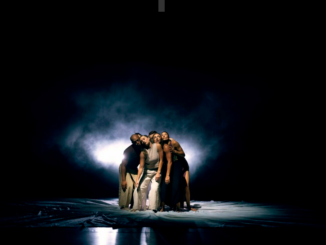
I see a lot of theatre, and I enjoy a lot of theatre, but it’s a rare show that’s able to cut through and grab you on a deeply personal level. That show is Massive Company’s The Brave.

Eight men, embodying bravery in body and souls, share their personal stories and experiences of their lives and masculinities.

Q’s stage is bare. Massive old-hand Scott Cotter begins alone on stage, a spotlight slowly building as his voice calls out in karanga. He acknowledges the people who came before us, an important theme – these men often define themselves in relation to others that have inspired and challenged them. One by one, the rest of the cast, ranging in age from 20-31, join him onstage. They walk around the room, taking us and each other in. Some walk solo, some walk together, powerful.

Directed by Massive founder Sam Scott, and Carla Martell and devised by the company, the show’s springboard were letters the cast were asked to write to important people who were in, or out of their lives. These letters – to fathers, mothers, grandmothers, and their own selves, are weaved through the show and form a powerful emotional backbone for the rest of the work to build around.