Theatre Scenes: Auckland Theatre Blog (Reviews, interviews and commentary)
18Apr/121

REVIEW: Sinarella (Mangere Arts Centre)

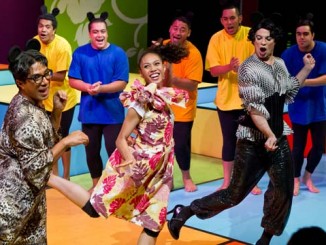
Perfectly Pitched Pacific Panto [by Sharu Delilkan]

The cast of Sinarella bursting into song and dance.

The theatre was electrically charged as we scrambled to find our seats. In fact my mate Liz and I ended up sitting separately because it was so full. Not to mention the fact that they added almost 6 new chairs stage left to accommodate the stragglers. Seeing the theatre packed to the gunnels was a great sight to behold, especially since the show has been running for more than a week.

Looking at the stage it was equally electric painted in a multitude of vivid fluorescent colours, complemented by the chorus’ multi-coloured t-shirts. And when the MC said “sit back and enjoy the show and laugh your bum bums off” you knew you were in for the ride of your life.

Sinarella, yet another feather in the Pacific Institute of Performing Arts’ (PIPA) cap as a joint production with Auckland Theatre Company, follows the sell-out season of Polly Hood in Mumuland.

8Sep/110

REVIEW: Raising the Titanics at Q Theatre

Raising the Titanics, Raising a Theatre  [by James Wenley]

Raising the Titanics

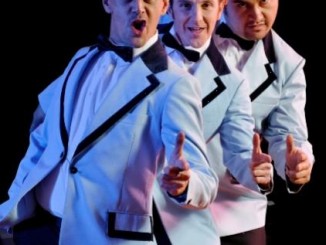
The Raising the Titanics Men

The Maori Volcanics show band in their 60s heyday were arguably our most famous exports. With members included bonafide legends Prince Tui Teka and Billy T James, they took their unique mix of song, comedy, and Maori culture around the world to the USA, Vietnam, Israel, Europe, playing to royalty and appearing on the same bill as other bonafide legends like Sammy Davis Jr.

The Titanics are a band like the Volcanics, though they never existed. Playwright Albert Belz and Producer Tainui Tukiwaho (who coincidentally recently graced our small screen playing Billy T James himself) initially explored doing a play involving the likes of Howard Morrison, Tui Teka and James before going with the story of a fictionalised showband. It’s a clever idea, able to honour the legends without being restricted by biographical details, and to pay tribute to an essential piece of kiwi music history.

It’s a history I fully admit to being quite ignorant of, and by paying homage to the showband culture Raising the Titanics succeeds the most. For those like me, here’s a clip of Billy T James and Prince Tui Teka performing with the Maori Volcanics… enjoy.

22Aug/110

PREVIEW: Raising the Titanics

Big shoes to fill, right on Q [by Sharu Delilkan]

Raising the Titanics

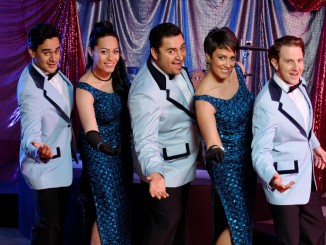
Roimata Fox (second on the left) stars in Raising the Titanics

Roimata Fox admits that the prospect of filling actor Miriama McDowell’s shoes, as Marea Reka in Raising the Titanics, was extremely daunting.

“It’s amazing what she does.  I’ve been watching her since I was 15 and have always looked up to her,” she says.

The 23-year-old actor has since gotten over those initial jitters and is in her element embodying her new role.

Having grown up in Ruatorea, a small town close to Gisborne, Fox says she has taken a few liberties with her east coast character to make it her own.

“Marea is Ngati Porou to the core and so am I.  That’s all I know and that’s all I can draw from because that’s basically who I am.”

In fact when she heard she had the role Fox packed her bags and headed back to Ruatorea to hang out with her aunties on a marae, as part of her research.

1Jun/110

REVIEW: The Brothers Size (Silo Theatre)

Brooding tale of Brotherhood [by James Wenley]

The Brothers Size

The Brothers Size

The Brothers Size is a play that ignites the senses.

Playwright Tarell Alvin McCraney has been burdened with all sorts of praise, the voice of his generation, the savior of American theatre. He grew up in Miami’s deprived Liberty City housing projects, and has worked with such prestigious theatrical institutions as the Royal Shakespeare Company and the Steppenwolf Theatre Company.

What he does isn’t anything new, he uses a potent mix of the language of now – the language of the street, hip hop – to tell a universal story in an engaging way.  That this play is receiving plaudits in an Auckland production by Silo Theatre is a testament to that. Good storytelling wins.

On a strictly narrative point A to point B level, the tale is a simple one. It’s about two brothers and what unites and divides them. Oshoosi Size (Pua Magasiva) is the ‘black sheep’, released from prison and taken into the care of head-to-the-ground elder brother Ogun (Jarod Rawiri), who tries to instill the value of hard-work and get him back on the right path. The presence of ex-con Elegba (Te Kohe Tuhaka), who ‘looked after’ Oshoosi while he was in prison, threatens to disturb the Size brotherhood.

Underneath this story are biblical and mythical echoes. McCraney has layered the story with elements of the West African Yorùbán Mythology – Ogun, for example, is the name of the God of Iron, Creativity and Violence, adding deeper metaphoric elements.  

17Apr/110

REVIEW: Polly Hood In Mumuland

Mumuland mesmerises Mangere [by Sharu Delilkan]

Pua Magasiva Polly Hood in Mumuland

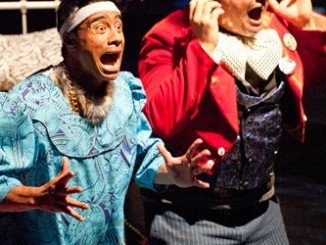
Pua Magasiva as the Wolf steals the show

It was an evening of firsts for me.  From experiencing a performance at the Mangere Arts Centre theatre for the first time, to seeing a Pacific Island flavoured musical extravaganza led by Goretti Chadwick, making her directorial debut.

Another first was also the collaboration between Auckland Theatre Company and the Pacific Institute of Performing Arts.

A clever twist on a traditional favourite, Little Red Riding Hood, the show is snappy and delivers in exuberant Polynesian style – all the elements of a great family show.

Watching the kids responding around me was a joy.  They were enraptured and entranced from the very first Munchkin-like, helium-induced introduction into a fantasy world.

The key to enjoying the show is to go with an open mind and to allow yourself to be a kid again – something we don’t do enough of in our ‘adult’ lives.

The real triumph of the show is a credit to the entire cast, deft directorial touches and joyously inspired musical arrangements by musical director Tama Waipara in collaboration with the PIPA students.