Theatre Scenes: Auckland Theatre Blog (Reviews, interviews and commentary)
19Mar/130

REVIEW: Hui (Auckland Arts Festival)

Whānau ties [by Matt Baker]

Hui

Hui

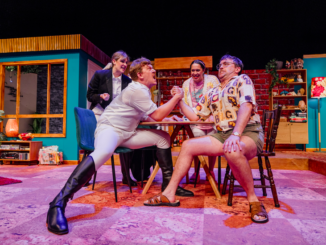
Family is an intrinsically universal concept, one to which all - regardless of (and sometimes in spite of) one’s upbringing - can relate. Instigated by the ultimate qualifier of death, Mitch Tawhi Thomas explores this concept, and the dynamics surrounding it, in the world premiere of the appropriately titled Hui. Said dynamics are illustrated through easily identifiable Kiwi characters, who, both in writing and performance, successfully avoid any sense of stereotypical portrayal. Yet, while the dialogue purged by these characters builds incrementally throughout the play to reach boiling point, it never quite reaches a coup de grâce.

In this respect, Stephen Butterworth as Tina comes closest to a full understanding of - and ability to express - the kernel of the idea within the writing. Butterworth chews up and spits out Thomas’ dialogue with rancor, but avoids dividing himself from the audience in the process.

Xavier Horan has a wonderfully even-toned quality to his voice as Pita, but the cracks in his character come out slightly too readily. Once he reaches the point of no return his anger is acutely focussed on Butterworth, without any sense of unjustified or overplayed force.

28Jan/130

Looking forward: What’s on my theatrical radar for 2013? (Part 2)

ATC, Silo and More! [by James Wenley]

What theatre surprises are being pulled out of the hat this year? Silo's White Rabbit Red Rabbit

Part One looked at what has caught my eye in the Fringe and Auckland Arts Festival (not too long to wait Festival lovers!). Now we cast our gaze on the rest of the 2013 theatre calendar. By all means stuff yourself silly during the Fests, but keep yourself some room, there is a lot more to come.

Living in the Future

There is a curious juxtaposition between the messaging of Auckland’s two highest-profile theatre companies.  In their 21st year, Auckland Theatre Company have chosen to look forward (towards that Waterfront Theatre most likely). The word for this year is “futurity”; the byline: “The future. Our hopes and dreams for it”. Silo is in the moment. In their season brochure Artistic Director Shane Bosher says: “The world hasn’t ended. And possibility still exists. This is about now.”  But Silo also seem to have gone back to their past to inform their present.

10Jan/132

Looking Back: 2012 – A Theatrical year in Review

Taking the Risk [by James Wenley]

2012 belonged to George Henare

“…It was this lack of “weight” (a not too easily defined term which an actor, if not a member of the audience, would understand) that Mr George Henare needs to work on if he wishes to pursue the acting profession. His is a good, powerful voice, he has strong features… yet a lot of these advantages are dissipated by his unsureness in terms of movement, distribution of body-emphasis, and… style.” -   Review of Awatea

It would be a brave reviewer indeed who would dare to write such sacrilegious words about Mr George Henare today. That was George Webby, in 1968, in an across-the-board withering attack on the original stage production of Bruce Mason’s Awatea. For Auckland Theatre Company’s 2012 revival, Sharu Delikan called Henare’s acting “flawless” and “truly inspired”, with Henare coming full circle to play blind patriarch Werihe Paku, whose son Matt Henare performed as in 1968. 2012 was a year that in many ways belonged to Henare, with headline performances in Awatea, Peach Theatre Company’s Death of a Salesman, and Educating Rita for the new Newmarket Theatre Company. Henare stocked up on the actor carbs to deliver three weighty performances indeed, along with a lightness of touch and twinkle in the eye, it was breathtaking to see Henare at work.

As I embarked this year on a Masters project looking at forgotten ‘landmark’ New Zealand plays from the 40-70s, Awatea defined my year. I went ‘behind enemy lines’ to see a little of that production come together. 2012 was a year I had one foot in the past, and one in the present. What would 2012 look like, in several decades time?

14Aug/120

REVIEW: The Pride (Silo)

What DOES it mean to be gay? [by Rosabel Tan]

The Pride

You want a play to change you. You want it to take you by surprise, to delight you, to hurt you. You want it to whisper in your ear three days later when you’re trying to focus during a staff meeting about strategy and best practice. You want it to be meaningful, in whatever way it intends.

In his notes, Alexi Kaye Campbell explains that in writing The Pride, he was interested in the notion of gay identity. “In what it means to be gay in 2009 and how that definition was formed.” We’re presented with the same three characters, Sylvia (Dena Kennedy), Oliver (Kip Chapman) and Philip (Simon London) dealing with the issues of identity and love and betrayal in two parallel timelines: the first is in London in 1958, when homosexuality was a crime punishable by up to two years in prison. Sylvia, a former actress, has been illustrating one of Oliver’s children’s books and has invited him over for dinner. She’s desperate that her husband Philip – an uptight real estate agent – and Oliver get on, and it’s clear from the suffocating silences and stammering conversation that they will, though it won’t be an easy ride.

8Aug/120

PREVIEW: The Pride (Silo)

A matter of pride [by Sharu Delilkan]

The Pride is all about relationships.

A heterosexual woman at the helm of a thrilling contemporary narrative predominantly focussed on the gay issues could have been a point of concern. But nothing could be further from the truth when it comes to Sophie Roberts' role as director for The Pride.

Her history of working on productions with gay themes has made her role in The Pride a natural progression in her career.

“I have done quite a few gay-oriented plays so I am quite comfortable dealing with those issues. I also like working with or highlighting the perspective of people on the fringes of society. I find such work more interesting and enjoy working in that territory. I strongly believe that theatre has a social and political function, which is why I seek out work that talks about these issues. And the fact that the gay marriage bill coming up in parliament gives the content of the play a lot more weight and relevance,” she says.

11Jun/120

REVIEW: Tribes (Silo)

Now how to express my experience? [by James Wenley]

The Family Tribe

Tribes comes to Auckland’s stage with a babble of hype and expectation. Only playwright Nina Raine’s second play (after Rabbit which Silo performed in 2008 ), it’s something of an international critical darling after its debut at London’s Royal Court in 2010. Just last week it won New York Drama Desk’s Outstanding play award. So no question it would be good then, but just how much. Answer? Very good indeed.

One of the titular tribes in the play are a family (unencumbered by surname) an internally-warring yet deeply self-protective family made up of Dad Christopher (Michael Hurst), Mother Beth (Catherine Wilken), boomerang twenty-something kids Daniel (Emmett Skilton) and Ruth (Fern Sutherland), and youngest Billy (Leon Wadham) who, while being careful not define him as such, is deaf.  The family have proudly bought him up in a ‘speaking’ environment, getting by with hearing aids and lip reading (a painfully slow learning process, credit to Mum).

This family’s default mode of communication, summed up by Christopher is: “Join in, have an argument”. Tribes launches us into a noisy family dinner; everyone speaking over the top of each other, getting their two cents in. It’s a revealing mixture of affection, annoyance and mocking that close familiarity breeds, and a very recognisable family dynamic indeed. But everyone? Billy, watching, processing, becomes my figure of attention, for the family are all but ignoring him. He says little, save for an odd “What are you talking about?”.

27Feb/120

REVIEW: Top Girls (Silo)

You Can Be a Successful Woman, Too! (Terms and Conditions Apply) [by Rosabel Tan]

Top Girls

When people talk about women having careers, there’s a trade-off implied: You can’t have a career and a family – one will suffer if you try, and if you pursue the former, you’re defeminised: there’s something wrong with you or, at the very least, your womb.

Society has come far to ensure that this is a trade-off we can make, but it’s clear we have a long way to go and it’s this position that Silo explores in Caryl Churchill’s Top Girls. Divided into three acts, the play opens with Marlene (Danielle Cormack) celebrating her recent promotion to managing director with an eclectic and incredible bunch of women from history: There’s Isabella Bird (Bronwyn Bradley) a nineteenth century explorer and writer, Lady Nijo (Nancy Brunning), a thirteenth century concubine to the Japanese emperor, Dull Gret (Sophie Hambleton), the painted figure who led an army of women to Hell, Patient Griselda (Rachel Forman), whose obedience was the centre of many a fourteenth century tale, and Pope Joan (Rima Te Wiata), who rose to her seat by masquerading as a man.