REVIEW: Punk Rock (Outfit Theatre Company)
Teen angst on overdrive [by James Wenley]
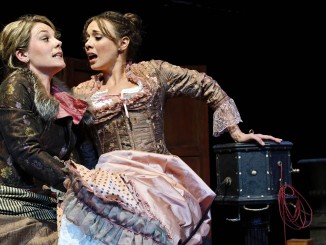
Pity the British teenager. There’s something about the British school system that has seen it spawn more than its fair share of films, television and plays eviscerating the subject. Alan Bennett’s thoughtful The History Boys, which Punk Rock has been compared to, took a fairly noble approach to student’s studying their final exam. Punk Rock by Simon Stephens is something else entirely. While presenting as a familiar story of a group of grammar school sixth formers studying for their A levels, it explodes into a punishing indictment on the horrors of high school and the teenage wasteland.
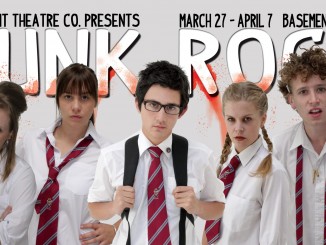
School uniforms don’t stop Punk Rock’s characters from expressing their identities – it’s all how you wear your blazer. Opening loud to a suitably raucous punk song, a recognisable assortment of archetypes parade around the stage. There’s the tightly buttoned nerd, the suggestive hottie, the sloppily dressed bully, and the guy so cool he gets away with wearing a non-regulation jacket. Within seconds, the nerd’s pants have been pulled down and carted offstage. Ah, so that’s how it’s going to be.
REVIEW: Ships Songs (Q Theatre)
Ships Songs Sings [by Sharu Delilkan]
The live band on stage kick starts the voyage dramatically, promising and definitely delivering a memorable theatrical journey.
Although I am a sucker for live music, I must admit that this combination can sometimes appears somewhat disjointed. The opposite of course is true with Ship Songs. In fact the live band is so involved in the whole process, they almost represent a multitude of characters, in addition to playwright and actor Ian Hughes' 14 characters. Their role as musicians and as the voice of reason is so effortlessly intertwined that it is almost hard to imagine them disassembled, after a while.
Ship Songs is essentially a simple ageless story of passion, love and pain, which everyone can relate to. The humour, which laces the entire piece together, is used sparingly but to great effect. But the fact that it’s based on his parent’s love story, makes the piece all the more poignant.
REVIEW: Little Histories of the Life Ordinary
Getting Lost in Space [by Rosabel Tan]
'Warning: This entire review might be a spoiler'
Little Histories of the Life Ordinary follows a girl named Frankie whose deepest desire is to travel to space. You’ll never be lonely up there, you see, and the moon is made of cabbage, so you’ll never go hungry either. Also, the Milky Way is made of milk. Problems – all of them: solved.
Devised by Sam Bunkall, Julia Croft, Alisha Lawrie-Paul and Josephine Stewart Tewhiu, Little Histories presents us with a series of vignettes showing Frankie at different stages of her life. Stewart Tewhiu plays her as a precocious, lonely child whose imagination is as infinite as the defences she’s constructing to protect herself. Quietly terrified of the world around her, she spends her days preparing for the arrival of the wormhole, which will take her into space with her pet snail, Gonzalez – who would rather spend his days reading his English to Maori dictionary.
Alisha Lawrie-Paul plays Frankie as an old woman, though this character feels too broadly drawn and lacks substance, and Julia Croft plays Frankie as a young adult, working as a receptionist at a taxi company and trying desperately to become friends with her colleagues. Croft’s Frankie was the most compelling of the three, and easiest to relate to because we were able to see her engaging with the world around her. Her painfully awkward attempts at social interaction were amusing yet heart-wrenching and her desperation to travel to space felt the most poignant because of her alternatives.
PREVIEW: Dialogue With A Mannequin (The Basement)
All in the Family [by Sharu Delilkan]
Cyan Corwine firmly believes that that you CAN make a silk purse out of a sow’s ear.
Her motto is that you can perform miracles with minimal expense, if you’re willing to think outside the box.
The creator of Dialogue With A Mannequin has made her mark in the industry creating sets and costumes on a shoestring budget.
In fact only recently she received a call from one of NZs major Television Networks asking her to do some set design. However she says she knew her reputation had preceded her when the conversation began with “We don’t have any money but…”
For the past seven years she has worked professionally as a costume designer, puppeteer, performer and general creator both here in New Zealand and New York, USA. 2011 saw Cyan work side-side in the art department and on stage with well-known comedian-husband Steve Wrigley on TV3’s the Jono Project and the hit comedy festival show Kevin the Musical.
Although Corwine doesn’t always want to be known for creating something out of nothing, that is exactly what she has had to do with Dialogue With A Mannequin.
REVIEW: Birds (The Mangere Arts Centre)
Real, Raw and Revealing [by Sharu Delilkan]
It was like dejavu arriving at The Mangere Arts Centre, from Avondale, only to be thrust back into the thick of my own neighbourhood.
Set in Avondale, Birds incorporates the suburb’s iconic sites -- Avondale Community Centre, Hollywood Cinema, Rosebank Road and Riversdale Reserve. These brilliantly selected audio-visuals, laced with witticism and whimsy, help create an effective fourth dimension.
Brave, insightful, poignant, real, raw and revealing are adjectives that come to mind when describing the new work Birds.
And as the playwright and director Dianna Fuemana says it was clearly her “ode to teenage-hood and their mums”.
I’ve seen a number of Samoan plays at The Mangere Arts Centre recently so it was refreshing to get a Niuean perspective. The fast-paced urban story distinguishes itself as it’s told through the eyes of a young Niuean boy, coming of age.
REVIEW: Much Ado about Nothing (Summer Shakespeare)
Shakespeare does it again! [by James Wenley]
Turns out that Much Ado about Nothing is actually much ado about quite a lot of things…
In some ways a ‘greatest hits’ of Shakespeare’s devices, Much Ado’s comedy takes in bumbling authority figures, a disguised seduction, various tricks played on characters, a Shrew-like Battle of the Sexes… there’s even a sort of small boy Richard III villain, and the plot threatens to get all Romeo and Juliet when, upon the suggestion of the friar (you have to watch out for them), the heroine Hero fakes her own death. In brief, such stuff that Shakespeare does so well.
The University of Auckland Outdoor Summer Shakespeare production, directed by Sam Pascoe, promises Shakespeare under the stars. With this weather, it’s more accurate to say Shakespeare under the clouds. No matter, for who would want to be watching the skies when the action on the lawn is so good.
Much Ado revolves around two couples – Claudio and Hero, who fall instantly in love with each other, and Benedick and Beatrice, who fall instantly in hate. But when they are tricked into thinking that the other one loves them, Benedick and Beatrice tie themselves instead into love knots.
REVIEW: The Seven Funerals of Charlie Morris (Elephant Nation)
Dying of Laughter [by James Wenley]
On a routine visit to the hospital after a blow to the head caused by his best friend re-enacting Fight Club, Charlie Morris is informed he has a terminal illness, and his days are numbered.
Now that is a profound life changing moment; too big to even begin to understand for people outside of it. When Charlie Morris tells his friends that he is dying, they’re immediate response is to say “Well, we’re all dying”. Charlie’s “just became more relevant”.
Thanks to many films and TV on the subject, there’s an awful lot of cliché associated with this sort of news too. Think the sort of plots (eg: The Bucket List) where the news spurs them to start living their life to the full, learning some important lessons along the way, and we end with a sad, but ultimately life affirming message.
Chris Neels’ new play The Seven Funerals of Charlie Morris acknowledges, then bypasses the cliché, dealing with a young man’s imminent mortality with sensitivity, honesty, and a thick coating of black humour. The subject matter may sound like a downer, but it’s treated with a truthful lightness and serious fun that that makes for truly charming and enjoyable story. And yes, the ending might even be a little life affirming too. It made me want to stand up cheer – but more on that later.
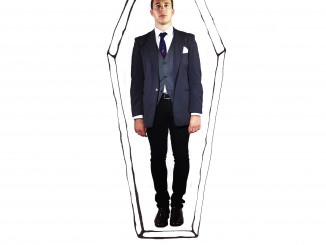
Charlie (Ash Jones) is being introspective in a bath tub as the audience enters the Basement Studio. A piano is cleverly hidden behind it, played live by Sean Webb, whose music through the play helps makes it sparkle. Chalk drawings on the walls suggest bathroom tiles and towel rack.
REVIEW: The Last Five Years (Last Tapes)
A show to fall in, and out of love.. [by James Wenley]
In the middle of Musical The Last Five Years, Jamie and Cathy pledge their loves and their lives in the song The Next Ten Minutes, which features both a tender proposal (“Will you share your life with me / For the next ten minutes? / .... And if we make it till then can I ask you again for another ten?”, and the wedding vows (“Will you share your life with me / Forever / For the next ten lifetimes?”). It’s a love song full of dreams and beautiful sentiment in its lyrics, but melodically it’s slow, heavy, with a hint of the sinister. With a real sense of musical foreboding, not the soaring love song the lyrics suggest – this love, and its platitudes, are doomed.
But you don’t have to wait to the end of the show to find this out, nor even this middle. Right at the beginning, Cathy (Cherie Moore) tells it blunt: “Jamie is over and Jamie is gone / Jamie's decided it's time to move on… And I'm still hurting”. Her story starts at the end, and moves backwards, from this moment of finality through to the first faltering beats of her heart. Jamie’s (Tyran Parke) story meanwhile goes from start to finish – from puppy dog eyes to the jaded brow. It’s a gimmicky device (See also, Harold Pinter’s Betrayal), but knowing at least the start and end of one of the stories makes us focus on all that goes on in between, trying to fit together the pieces of why and how.
Written and composed by Jason Robert Brown, the musical has achieved cult success, premiering in Chicago in 2001 and playing off-Broadway the following year. Brown drew from his own failed marriage in writing the material, which led to threats of a legal challenge from his ex-wife which saw Brown rewrite one of the songs to less overtly mirror his own life. Whether the creation of the show was therapy or otherwise, and there certainly seems to be a hint of introspection, the end product is an articulate look at relationship stages, dynamics, and mutual destruction.
REVIEW: Play Me Deadly (Rebels and Robots)
B-Theatre Fun: So bad its good [by James Wenley]
Bela Lugosi’s career was rock bottom by the time he was working with infamously bad film director Ed Wood. After gaining success as Dracula in the 1930 film, Lugosi became a regular in horror films. By the 1950s however, he was washed up and irrelevant until Ed Wood bought him out of obscurity to star in his low budget B movies. Bela Lugosi’s death, of a heart attack aged 73, did not stop Ed Wood from having him star in one of his movies one more time – using only one day’s worth of silent test footage and a body double, Bela Lugosi would receive top billing for science fiction shlock Plan 9 from Outer Space.
Or so history records. This week at the Basement Studio, Play me Deadly tells its own ‘B-Theatre’ version about what really was behind Lugosi’s death, and the sinister plan behind the film Plan 9 from Outer Space.
The first full length play by Louis Mendola (it zips along at just under an hour), it shamelessly embraces the mood, clichés and outrageously unbelievable plots of the “bad” B-Movie film. Bela Lugosi has turned up dead - bad news for Private Detective Richard Marlowe (Sam Bunkall, proving a go to actor for American accents after his work in Glorious) who has been trying to track the reclusive actor down. A flashback brings us to the start of the case, where he is employed by Lugosi’s wife Olga (Leisha Ward-Knox, brilliantly over-acting) to find him. More flashbacks and montages follow as an outlandish conspiracy emerges, and we meet a strange collection of characters including angora loving director Ed Wood (Roberto Nascimento), bizarre sex symbol Vampira (Leisha), film star Natalie Wood (Leisha) and jumpsuit wearing Russian Leon Theremin, the creator of the iconic electronic instrument the theremin, which is played without being touched.
A live theremin is played onstage by Glyn Evans as we enter the Basement Studio. It’s entrancing to watch as he moves and pulses his hands in mid-air, and a strange assortment of sounds emerge from the peculiar looking device. As an observer it’s difficult to work out the coloration, but it seems as he moves his hands further away from the instrument it becomes deeper. Evans even manages to throw a distorted ‘Somewhere over the Rainbow’ into the preshow mix. Sharply suited, he looks the part, and the live theremin soundtrack is a very special element of the play, doing much to evoke the atmosphere of the sci-fi genre of the 50s. He returns to stage as the mute servant of Leisha’s Leon Theremin, the instrument revealed to have mind-control powers on the characters, who are hypnotized by its sound.