REVIEW: Educating Rita (Newmarket Stage Company)
A Lesson onstage [by Matt Baker]
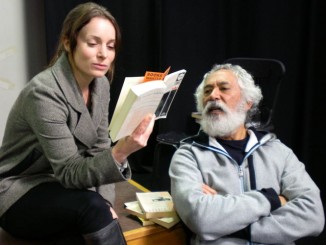
The play was written by Willy Russell and premiered at the Donmar Warehouse in 1980. In 1983, Russell wrote the screenplay for the film that would go on to win Best Picture, Best Actor (Michael Caine), and Best Actress (Julie Walters) at the BAFTA Awards. A remake was proposed with Denzel Washington and Halle Berry. As a film it stands on its own, as a play not so much.
Though it should. The story is fundamentally solid. Pygmalion mythology and the concepts of power, knowledge, authority, jealously, and love (not necessarily romantic), especially between a man and a woman, are filled with potential dynamism. The action, however, is somewhat stagnant and practically hinders this. It is a heavily dialogue driven piece, which, ironically, would maintain what poignancy it has if adapted to a radio play. Russell did this in 2009. Unfortunately, he was 29 years too late. The first three or four scenes could easily be condensed into one, which would allow for the actual conflict to surface earlier in the first act, as opposed to making the audience wait until moments before the interval. The characters’ points of views, the conflicts, the reactions, even the jokes, are all predictable, and Rita’s penultimate speech to Frank robs the audience of the work they’ve done, explaining everything his character thinks and feels. This is not to say that the play is bad, merely that it does not achieve what it could based on its premise.
REVIEW: Drowning in Veronica Lake (Q Season)
The Fame Monster [by James Wenley]
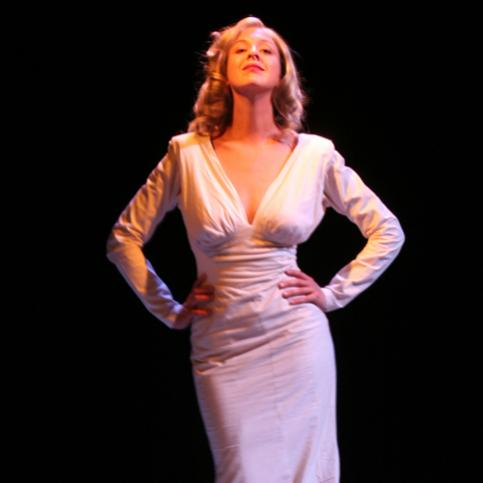
There’s commentary within this show about the difference between celebrity and stardom. Celebrity is flash in the pan stuff. Stardom is enduring. You counted. People remember. Movie femme fatale Veronica Lake has the ingredients for stardom – a troubled back-story, ambition, a face that lights up the screens. She was very much a screen celebrity of the 1940s. But a star? She died, age 50, her career long behind her, in near obscurity. That’s a long way to fall.
Veronica Lake, real name Constance Frances Marie Ockelman, was most famous in her heyday for her studio constructed trademark ‘peek-a-boo’ hairstyle covering her right eye. She appeared in films like Sullivan’s Travels and The Black Dahlia. Now, she’s a screen siren curio, known mainly to the biggest movie buffs. I’ve never seen any of her films. I hadn’t heard of her until this play, Drowning in Veronica Lake, reached my consciousness.
The local creative team led by Director Simon Coleman, have rediscovered Lake and found in her rise and fall story wider resonances on fame and image. While the show employs great use of juicy biographical information, relayed by Veronica (Alex Ellis) herself, hers is a story we have largely heard before. A young ingénue embraced by the Hollywood and fame system, built up, celebrated, then spat out: she blamed her diminishing career prospects on the series of bad films the studio placed her in. On the way she had four marriages and an increasing dependence on the alcohol. She burned brightly, but briefly. In her we might be reminded of the Marilyns, or latter day Britneys or Lindsays. How do you remain a real person under the weight of fame? And what happens... when it’s gone?
REVIEW: The Laramie Project: 10 Years Later (The Basement)
Aged Perfectly [by Matt Baker]
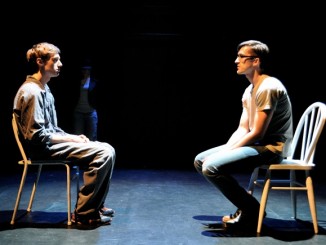
How do you measure change? This is one of the questions that drove the Tectonic Theater Project to revisit the town of Laramie, Wyoming, ten years after their incredibly successful theatrical project. It is an important question, especially regarding the content of the play, and after seeing Alacrity Productions and The Moving Theatre Company’s version of The Laramie Project: 10 Years Later I am not only relieved, but also grateful, that this play has been put in the hands of such dedicated practitioners.
Scripted entirely verbatim from interviews as per the original, I am impressed at TTP’s ability to construct a sound narrative with very little need for their own comments to direct the story. Just when the play feels that it is going to be nothing more than a series of social commentaries, it changes pace with the introduction of Matthew Shepherd’s father (Shadon Meredith). Later, when the play begins to feel that it is becoming a series of legislative reports, we are introduced to the men responsible for Matt’s death.
REVIEW: Taro King (Kila Kokonut Krew)
KKK still Kings [by Sharu Delilkan]
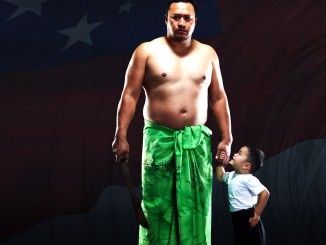
There was almost a carnival atmosphere when entering the Mangere Arts Centre, a setting befitting the Kila Kokonut Krew’s 10th year anniversary celebrations featuring the production that put the company on the map, Taro King.
Unfortunately I don’t have the benefit of being able to compare it with the first time it was staged. So all I can give is my reaction to what it was like seeing it with fresh eyes.
Just as when we saw Indian Ink Theatre Company’s first show Krishnan’s Dairy recently, after a decade, it was great to see where KKK started. And more importantly it was interesting to find out the impetus for playwright Vela Manusaute to write this iconic slice of Pacific Island life in Aotearoa.
For those of you who don’t know, Manusaute (who also plays Sammy) drew on what he felt and experienced working in an Otara supermarket way back in 1997.
Walking into the theatre and being greeted by DJ JXN (Glen Jackson) on stage drew me in immediately. I couldn’t help chuckling to myself when I read the words on his tee shirt ‘Shout Yr Maouf’. That definitely set the tone for what was to come. I found it even more interesting the way people tended to go up to DJ JXN and shake his hand on stage before taking their seats – something that would only happen in a South Auckland theatre – chur! And using him to do the ‘turn your cellphones off” and supermarket announcements was genius.
REVIEW: The Pride (Silo)
What DOES it mean to be gay? [by Rosabel Tan]
You want a play to change you. You want it to take you by surprise, to delight you, to hurt you. You want it to whisper in your ear three days later when you’re trying to focus during a staff meeting about strategy and best practice. You want it to be meaningful, in whatever way it intends.
In his notes, Alexi Kaye Campbell explains that in writing The Pride, he was interested in the notion of gay identity. “In what it means to be gay in 2009 and how that definition was formed.” We’re presented with the same three characters, Sylvia (Dena Kennedy), Oliver (Kip Chapman) and Philip (Simon London) dealing with the issues of identity and love and betrayal in two parallel timelines: the first is in London in 1958, when homosexuality was a crime punishable by up to two years in prison. Sylvia, a former actress, has been illustrating one of Oliver’s children’s books and has invited him over for dinner. She’s desperate that her husband Philip – an uptight real estate agent – and Oliver get on, and it’s clear from the suffocating silences and stammering conversation that they will, though it won’t be an easy ride.
PREVIEW: The Pride (Silo)
A matter of pride [by Sharu Delilkan]
A heterosexual woman at the helm of a thrilling contemporary narrative predominantly focussed on the gay issues could have been a point of concern. But nothing could be further from the truth when it comes to Sophie Roberts' role as director for The Pride.
Her history of working on productions with gay themes has made her role in The Pride a natural progression in her career.
“I have done quite a few gay-oriented plays so I am quite comfortable dealing with those issues. I also like working with or highlighting the perspective of people on the fringes of society. I find such work more interesting and enjoy working in that territory. I strongly believe that theatre has a social and political function, which is why I seek out work that talks about these issues. And the fact that the gay marriage bill coming up in parliament gives the content of the play a lot more weight and relevance,” she says.
PREVIEW: Renee Lyons and The Triumphants
Nick Inspires [by James Wenley]
"He can’t walk or talk but he pushes weights at the gym that would have me in a crumpled heap crying for my mama if I so much as attempted it!"
Auckland actor Renee Lyons (Joseph & Mahina) was all set to do a one woman solo show. She’d got funding (big tick!), had been working on the story for the past six months, and was participating in an Incubator workshop led by the creative team at Red Leap Theatre to further hone her idea. Except, when it was her turn to speak about her project, another story entirely came out of her mouth....
It was the real life story of Dunedin’s Nick Chisholm, a sportsman and adrenalin junkie who suffered a major stroke during a Rugby match in 2000 which left in a condition called ‘locked in syndrome’ – unable to move or speak, it was believed he was brain dead. His is a remarkable story of adversity to communicate with the world.
Renee had been sitting on the idea of turning his story in a play for two years, and at the Incubator it just seemed like the time was right. Arts Alive were supportive of the new idea, and NICK now forms part of The Triumphants double bill with another one-woman play ...And then you die performed by Aidee Walker and written by Thomas Sainbury. Both are directed by Hackman winner Abigail Greenwood.
As a fellow participant at the Incubator week, I was eager to hear more from Renee about her one-woman show and how it was developing for its debut season.
EXCLUSIVE REVIEW: Sleepover, Next Big Thing Festival (ATC)
The show that sent me to Sleep [by James Wenley]
Did you hear about the show where a woman had an affair with a cake and all the audience members were dressed in their Pyjamas?
If you didn’t, there’s a very good reason. SLEEPOVER was the most mysterious, and the most exclusive event of Auckland Theatre Company’s recent Next Big Thing Festival (for which you definitely should have heard of Tusk Tusk and Checkout Chicks). It ran for only two nights, taking over the entirety of the Basement Theatre from 11pm, and could only accommodate 20 audience members per night.
I was one of the lucky 40, and the only invited reviewer. And so that’s the other reason - I haven’t posted my review till now. So time to reveal all.
This has to be the one of the strangest shows I have had to review; as the night went on the small audience became an important performer in the show itself. And it was the longest – we were there from 10:30 to collect our Sleepover Lanyards and meet our fellow audience members, the ‘show’ started at 11pm, and we went to bed around 3am, struggled to sleep, then awakening circa 7am and getting kicked out of the venue at 8:30am.
For the purposes of this review I’d like to give some suggestion of what the event was like for those who missed out or weren’t brave enough to don their PJs, if it worked, and whether the ‘sleepover’ concept can be more than just a one night stand.